
What Is A3 Problem Solving? A Complete Guide for Service Operations
Imagine walking into a location where drive-thru times have ballooned by 90 seconds over the past month. The GM says it is the new menu items. The shift lead says it is the new hires. The kitchen team says it is the POS system. Everyone has a theory. Nobody has proof. And the problem keeps getting worse.
This is exactly the kind of mess A3 Problem Solving was built to untangle.
What Is A3 Problem Solving?
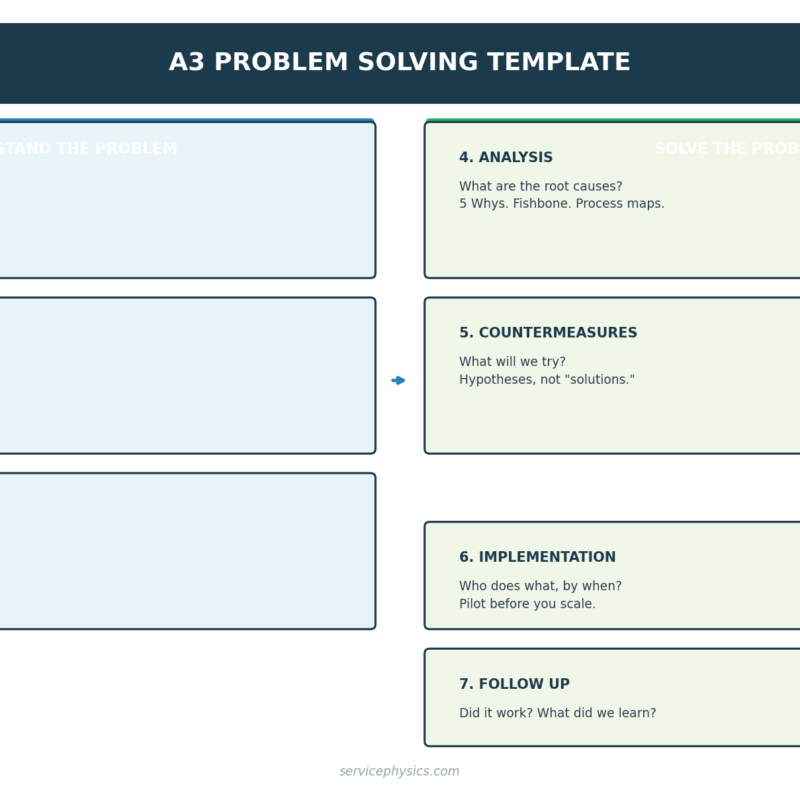
A3 Problem Solving is a structured framework from the Toyota Production System that forces you to work through a problem methodically, on a single sheet of A3-sized paper (11 by 17 inches). That constraint is the whole point. When you only have one page, you cannot hide behind fifty slides of data or a twenty-page report that nobody reads. You have to be clear. You have to prioritize. You have to actually think.
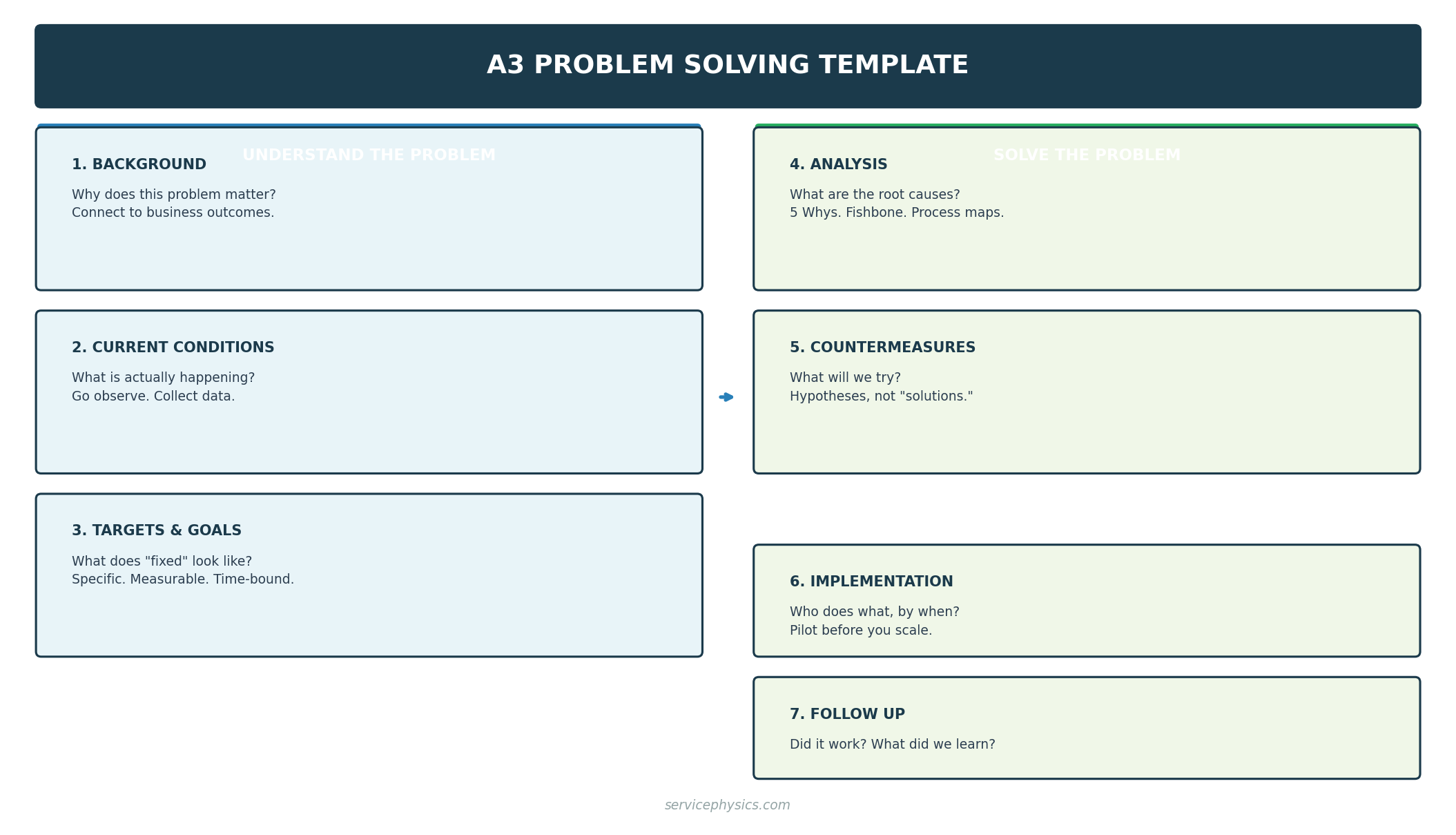
The A3 walks through seven sections: Background, Current Conditions, Targets and Goals, Analysis, Proposed Countermeasures, Implementation Plan, and Follow Up. Each section builds on the one before it, which means you cannot skip ahead to the fun part (proposing fixes) without doing the hard part first (understanding what is actually broken).
Why It Works So Well in Service Operations
Here is what makes A3 different from the way most service businesses solve problems: it slows you down on purpose.
In multi-unit operations, speed is the default mode. Something breaks, someone fixes it, everyone moves on. The problem is that “fixes” applied without understanding root causes tend to create new problems. You patch the drive-thru bottleneck by adding a person to the line, but now your labor cost spikes and you have two people bumping into each other in a workspace designed for one. That is not solving. That is shuffling.
A3 forces you to sit with the problem long enough to actually understand it. And when you do that across dozens of locations, something powerful happens: you stop fighting the same fires over and over.
Walking Through the Sections
Background
Why does this problem matter? Not “what is the problem” but “why should anyone care?” If you cannot connect the problem to a business outcome that matters (customer experience, labor cost, throughput, safety), it probably is not worth an A3. This section keeps teams honest about where to spend their problem-solving energy.
Current Conditions
This is where most teams want to rush. Do not let them. Current Conditions means going to where the work happens and observing what is actually going on. Not what the SOP says should happen. Not what the GM thinks happens. What actually happens, right now, on the floor, during the Tuesday lunch rush.
Data matters here. A3 thinking is only as strong as the observations feeding it. If your current conditions section is based on opinions instead of measurements, your countermeasures will be guesses instead of solutions.
Targets and Goals
What does “fixed” look like, specifically? Not “improve throughput” but “increase drive-thru transactions per labor hour from 14 to 18 within 60 days at pilot locations.” When targets are vague, it becomes impossible to know whether your countermeasures worked. When they are specific and time-bound, accountability becomes automatic.
Analysis
Now you dig into root causes. Tools like the 5 Whys, fishbone diagrams, or process observation help teams move past symptoms. This is usually the most uncomfortable section because the root cause is often something nobody wants to say out loud. Maybe the training program is not working. Maybe the layout redesign from last year created a bottleneck nobody predicted. Maybe the standard everyone agreed to is the wrong standard.
Intellectual honesty here is everything. If you lie to the A3, the A3 will lie to you.
Proposed Countermeasures
Notice: countermeasures, not solutions. That word choice is intentional. A “solution” implies you have solved it forever. A “countermeasure” implies you have a hypothesis about what will work, and you are going to test it. This mindset connects directly to kaizen: every improvement is an experiment. You try, you measure, you learn, you adjust.
Implementation Plan
Who does what, by when, with what resources? This section is where good intentions become real work. In multi-unit operations, it also needs to address how you will pilot at a few locations before rolling out everywhere. Because a countermeasure that works brilliantly at your highest-performing location might fall apart at your most challenged one.
Follow Up
This is where organizations separate themselves. Most teams implement a fix and move on. The good ones come back, check the data, and ask: did it actually work? Follow Up closes the loop. It connects A3 to the PDCA cycle (Plan, Do, Check, Act) and ensures that “we fixed it” is not just a feeling but a fact.
The Mistakes That Kill A3 Efforts
The number one mistake is jumping to countermeasures before the analysis is done. We see it constantly. A team spends ten minutes on Current Conditions, five minutes pretending to do Analysis, and then forty-five minutes debating which fix they like best. That is not A3. That is a brainstorming session wearing a lean costume.
The second mistake is treating the A3 as a form to fill out instead of a thinking process. When people are completing boxes to check a compliance requirement, the A3 has become the very thing it was designed to eliminate: waste.
What Makes A3 So Valuable for Multi-Unit Operators
When a district manager solves a throughput problem at one restaurant using an A3, that document becomes a teaching tool. Other locations can review the analysis, understand the root cause, and adapt the countermeasure to their own context. Over time, A3s compound into organizational knowledge. The whole network gets smarter, not just the one location that had the problem.
At Service Physics, we use A3 Problem Solving with clients across the restaurant, healthcare, and multi-unit service industries. We pair it with time and motion studies and data analysis to make sure the Current Conditions section is grounded in reality, not assumptions. Because the A3 is only as good as what you feed it.
Frequently Asked Questions
What is the difference between A3 Problem Solving and a root cause analysis?
Root cause analysis is one piece of the A3. It lives in the Analysis section. But A3 goes further by structuring the entire journey from defining the problem through implementing and verifying countermeasures. Think of A3 as the full road trip and root cause analysis as one stop along the way.
Do I need special software to do A3 Problem Solving?
No. The original intent is literally pencil on paper. Many organizations use digital templates, which is fine if it helps your team collaborate across locations. But if the tool adds friction without adding clarity, grab a piece of paper and a pencil. The thinking is the product, not the document.
How long should an A3 take to complete?
It depends entirely on the problem. A straightforward operational issue might take a week. A systemic problem affecting multiple locations could take several weeks of data collection and observation. The key is not to rush the analysis for the sake of speed. A fast A3 that misidentifies the root cause costs you more time than a slow one that gets it right.
Related Glossary Terms
A3 Problem Solving works best when paired with other operational improvement tools. Value Stream Mapping (M&IF) helps you visualize the end-to-end process so you can pinpoint where A3s will have the greatest impact. And once you implement countermeasures, tracking TPLH (Transactions per Labor Hour) tells you whether those changes actually moved the needle on productivity.

Insights in your inbox
Stay ahead of what’s next in service operations. Sign up for the Service Physics mailing list to get our exclusive insights in your inbox.