
What Is Patient Flow? Why Hospitals Lose Capacity Without Losing Beds

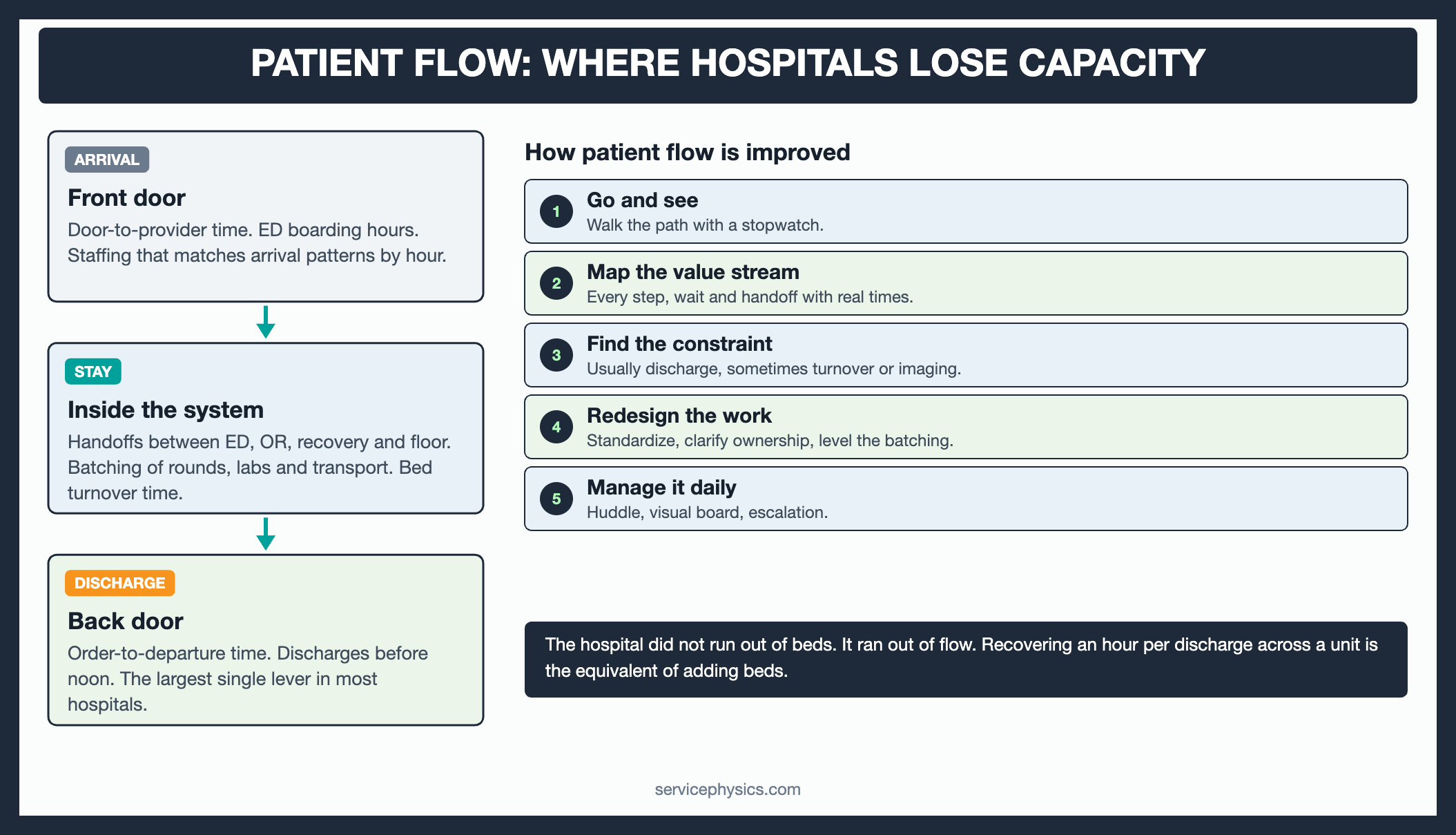
A 300-bed hospital is “full” at 10am. The emergency department is boarding twelve admitted patients in hallway beds. Elective surgeries are being delayed because there is nowhere to send patients from recovery. Meanwhile, on the medical floors, twenty patients have discharge orders written and are waiting for a ride, a prescription, or a final sign-off. By 4pm, most of those beds are empty again. The hospital did not run out of beds. It ran out of flow.
This pattern repeats in hospitals and clinics every day, and it is the reason capacity problems so often persist after a new wing is built. The constraint is rarely the number of beds. It is how patients move between them.
What Is Patient Flow?
Patient flow is the movement of patients through a healthcare setting, from arrival to discharge, across every department, handoff, and wait in between. It covers how quickly a patient is seen, how long each step takes, how long they wait between steps, and how smoothly they move from one unit or team to the next. Good patient flow means patients get the right care at the right time without unnecessary waiting, and the organization gets full use of its beds, rooms, staff, and equipment.
The concept comes from operations management and lean thinking, where the same idea is applied to any process that moves a unit of work through a system. In a hospital, the unit of work is a person, which raises the stakes but does not change the mechanics. Waiting is still waste, bottlenecks still limit throughput, and variability still compounds through every downstream step.
Patient flow is usually measured with a handful of throughput and timing metrics: door-to-provider time, length of stay, bed turnover time, discharge-order-to-departure time, ED boarding hours, and the percentage of discharges completed before noon. Each one is a window onto a different part of the same system.
Why Patient Flow Matters
Poor flow shows up as symptoms that look unrelated until you trace them back. Emergency department overcrowding is usually a discharge problem upstairs. Surgical cancellations are usually a recovery-to-floor handoff problem. Staff overtime and burnout are usually the cost of teams improvising around delays that the system should have designed out.
The financial impact is significant because capacity is the hospital’s most expensive asset. A bed that sits occupied by a patient who is medically ready to leave produces no revenue and blocks an admission that would. Recovering even an hour or two per discharge across a unit is the equivalent of adding beds, without the capital, the staffing, or the eighteen months of construction.
And the patient experience is inseparable from flow. Waiting in a hallway, being moved three times, or sitting in a room for six hours after being told you can go home are the moments people remember, and they drive the satisfaction scores that increasingly matter to reimbursement.
What Slows Patient Flow Down
Most flow problems are handoffs and waits rather than the clinical work itself. The common ones are consistent across organizations.
Discharge delays
The largest single lever in most hospitals. Discharge depends on a chain of small tasks across physicians, nursing, pharmacy, case management, transport, and family, and any one of them can hold a bed for hours. Discharges that could happen at 10am routinely happen at 4pm.
Bed turnover
The time between one patient leaving and the next arriving is often two or three times longer than the cleaning itself. The rest is notification lag, queueing, and unclear ownership of the room’s status.
Batching
Rounds, discharges, lab draws, and transports done in batches create surges that overwhelm the next step and then leave it idle. Smoothing work across the day is one of the highest-return changes available.
Unclear ownership at handoffs
When a patient moves from the ED to a floor, from the OR to recovery, or from inpatient to home, responsibility for the next action is often ambiguous. Each ambiguity is a wait.
Staffing that does not match demand
Arrival patterns are predictable by hour and day, but staffing is often set by shift and by budget. Mismatch produces queues at the front door and idle time at the back.
How Patient Flow Is Improved
At Service Physics, we treat patient flow the way we treat any service system: observe it, measure it, find the constraint, and redesign the work around it. The approach has five steps.
1. Go and see
Walk the patient’s path from arrival to discharge with a stopwatch and a notebook. Time and motion observation reveals where the minutes actually go, which is rarely where the org chart suggests.
2. Map the value stream
Lay out every step, wait, and handoff on one page, with real times attached. Value stream mapping makes the waste visible to clinical and operational leaders at the same time, which is what makes agreement on priorities possible.
3. Find the constraint
Every flow system has one step that limits throughput at any given time. In hospitals it is often discharge, sometimes bed turnover, occasionally imaging or a specific specialty consult. Improving anything else first is wasted effort.
4. Redesign the work
Standardize the constrained step, clarify ownership at each handoff, level the batching, and match staffing to demand by hour. Changes are tested on one unit before they scale.
5. Manage it daily
Flow degrades without attention. A short daily huddle with a visual board of the day’s discharges, bed status, and escalations keeps the system running and surfaces problems while they can still be fixed.
What It Looks Like in Practice
On a medical unit, this might mean a discharge process redesigned so that the tasks needed for a next-day discharge are started the afternoon before, with a visual board showing each patient’s readiness and a named owner for every open item. On the ED side, it means a direct-bedding protocol that matches arrival patterns and removes the triage-then-wait step for most patients. For environmental services, it means real-time bed status and a standard turnover sequence with a target time that is measured every day.
None of that requires new construction or new software. It requires seeing the operation as a system, measuring it, and building the routines to run it. That is the same discipline we apply in restaurants, where the unit of work is an order instead of a patient, and the results are the same: more capacity from the same footprint.
Frequently Asked Questions
What is the difference between patient flow and throughput?
Throughput is a measure: how many patients a unit or a hospital can move through in a given period. Patient flow is the system that produces it: the steps, handoffs, waits, and staffing that determine how smoothly patients move. Improving flow is how you improve throughput without adding beds or staff.
Why do hospitals focus on discharge before noon?
Because discharges are the main source of bed supply and admissions arrive throughout the day. When discharges cluster in the late afternoon, admitted patients board in the ED all morning waiting for beds that will empty later. Moving discharges earlier releases capacity when it is needed, which is why discharge-before-noon percentage is such a common flow metric.
Can patient flow be improved without new technology?
Yes, and usually that is the right place to start. Most flow loss comes from waits, handoffs, batching, and unclear ownership, none of which software fixes on its own. Once the work is standardized and managed daily, technology that supports bed status, task tracking, or forecasting adds value. Before that, it tends to automate the existing delays.
Related Reading
Patient flow is where several of the ideas on this blog meet: value stream mapping for seeing the whole path, time and motion studies for measuring it, a service delivery system for redesigning it, and a management system for keeping it running.
Recover Capacity in Your Hospital or Clinic
Service Physics helps healthcare organizations improve patient flow, remove waste from clinical and administrative workflows, and align leaders on the few metrics that move capacity. See how we work with healthcare organizations or book a strategy call.

Insights in your inbox
Stay ahead of what’s next in service operations. Sign up for the Service Physics mailing list to get our exclusive insights in your inbox.