
What Is a Management System? How Service Brands Lead with Structure Instead of Reaction

Ask ten district managers at the same brand what they do on a store visit and you will get ten answers. One walks the line and checks temperatures. One sits in the office and reviews the P&L. One spends the visit on the phone with the region. Each of them is working hard. None of them is running the same play, so the stores they lead do not run the same way either.
This is what leadership looks like without a management system: capable people reacting to the day in front of them, with no shared rhythm, no shared metrics, and no shared definition of what a good week looks like.
What Is a Management System?
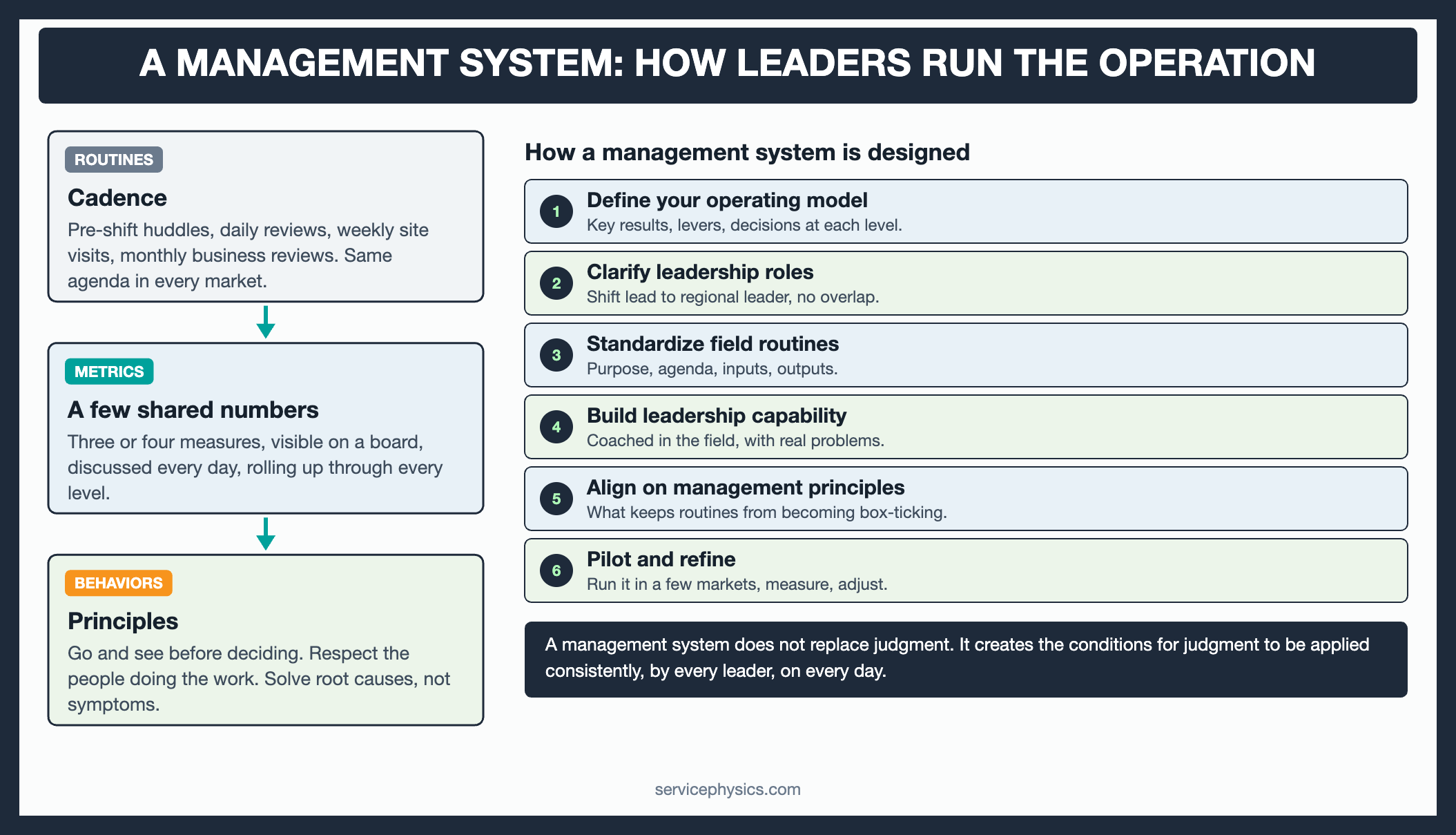
A management system is the structured set of routines, roles, metrics, and behaviors through which leaders run an operation. It defines what leaders at each level look at, how often, in what forum, and what they do about it. It is the operating system for leadership, in the same way a service delivery system is the operating system for the frontline.
The concept is central to lean management and the Toyota Production System, where it is sometimes called daily management or lean management system. It covers things like the cadence of huddles and reviews, the visual boards that make performance visible, the standard routines a manager follows on a shift or a site visit, and the escalation paths that connect a problem on the floor to someone who can fix it.
A management system does not replace judgment. It creates the conditions for judgment to be applied consistently, by every leader, on every day, not just by the best ones on their best days.
Why Management Systems Matter in Multi-Unit Operations
Most service brands invest heavily in operational standards and comparatively little in how those standards are managed. The result is that performance depends on individual managers. Strong ones produce strong stores. When they move on, the store drifts. Scale makes this worse: a brand with 300 locations has 300 versions of leadership.
The symptoms are consistent. Leadership habits vary and follow-through is unreliable. Goals set at the top are misaligned with what teams are measured on below. There is little visual management, so problems surface late. Leaders spend their time reacting rather than improving, because nothing in their week is designed for improvement.
A designed management system brings rhythm and structure to leadership. It makes the right behaviors systematic rather than personal, aligns every level on the same few metrics, and builds the habit of solving problems at the level where they occur.
How a Management System Is Designed
At Service Physics, management system design follows six steps, all built with the leaders who will live in the system rather than handed to them.
1. Define your operating model
Clarify how the business is meant to run: the key results, the levers that drive them, and the decisions that need to be made at each level. Everything else in the system serves this.
2. Clarify leadership roles
Define what a shift lead, a general manager, a district manager, and a regional leader are each accountable for, and remove the overlap. Ambiguity at the top produces ambiguity everywhere below it.
3. Standardize field routines
Design the recurring routines: pre-shift huddles, daily reviews, weekly site visits, monthly business reviews. Specify their purpose, agenda, inputs, and outputs so they run the same way in every market.
4. Build leadership capability
Teach the routines by practicing them, on-site, with real problems. Coaching in the field beats classroom training because the system is learned in the environment where it has to work.
5. Align on management principles
Agree on how leaders behave: go and see before deciding, respect the people doing the work, solve root causes rather than symptoms. Principles are what keep the routines from becoming box-ticking.
6. Pilot and refine
Run the system in a few markets, measure what changes, and adjust. A management system is itself something to improve, and the first version is never the final one.
Common Mistakes in Management System Design
The most common mistake is mistaking a reporting cadence for a management system. Weekly calls where numbers are read aloud are not management; they are narration. The system has to include what leaders do about the numbers. A second mistake is designing the system for headquarters. If the routines create work for the field without helping the field, they will be abandoned within a quarter.
Brands also tend to overload the metrics. Twenty KPIs on a dashboard means none of them drive behavior. Three or four, visible on a board and discussed every day, will. And finally, many companies roll out routines without teaching the underlying problem-solving skill, so huddles happen but nothing gets solved.
What It Looks Like in the Field
In foodservice, a management system usually shows up as standardized field leadership routines that district and general managers follow on every visit and every shift, clear role definitions across restaurant leadership levels, and performance visibility tools that put the few metrics that matter in front of the team where the work happens.
In healthcare, the same discipline applies to multi-site care team management: standardized leadership practices across clinics and units, redesigned leadership roles that keep clinical leaders focused on patient flow and quality, and a shared cadence that connects unit-level problems to system-level decisions.
In both settings the goal is connected leadership from the executive team to the frontline, learned through practice rather than presentation, and improved through repeated cycles.
Frequently Asked Questions
What is the difference between a management system and a quality management system?
A quality management system, such as one built to ISO 9001, is a documented framework for meeting quality requirements and is often compliance-driven. A management system in the lean sense is the daily operating rhythm of leadership: routines, metrics, and behaviors that drive execution and improvement. The two can coexist, but the lean management system is about how leaders actually spend their time.
How long does it take to implement a management system?
Designing the system and piloting it in a few markets typically takes one to two quarters. Building the habits across a whole field organization takes longer, and the pace is set by how quickly leaders practice the routines rather than by how quickly the documents are written.
Does a management system reduce a manager’s autonomy?
It changes where autonomy is spent. A management system standardizes the routine parts of leadership so that managers have more time and better information for the judgment calls that actually differ by location. Most managers experience it as less firefighting and more coaching.
Related Reading
A management system is the leadership counterpart to a service delivery system and is usually the mechanism that sustains an operations strategy. The problem-solving routine at its core is described in our guide to A3 problem solving, and the metrics it runs on are covered in what is TPLH.
Turn Fragmented Leadership into a System That Scales
Service Physics designs management systems with your leaders, in the field, so consistent execution no longer depends on who is on shift. Learn more about Management System Design or book a strategy call.

Insights in your inbox
Stay ahead of what’s next in service operations. Sign up for the Service Physics mailing list to get our exclusive insights in your inbox.