
Room Turnover in Hospitals and Hotels: The Same Problem in Two Industries

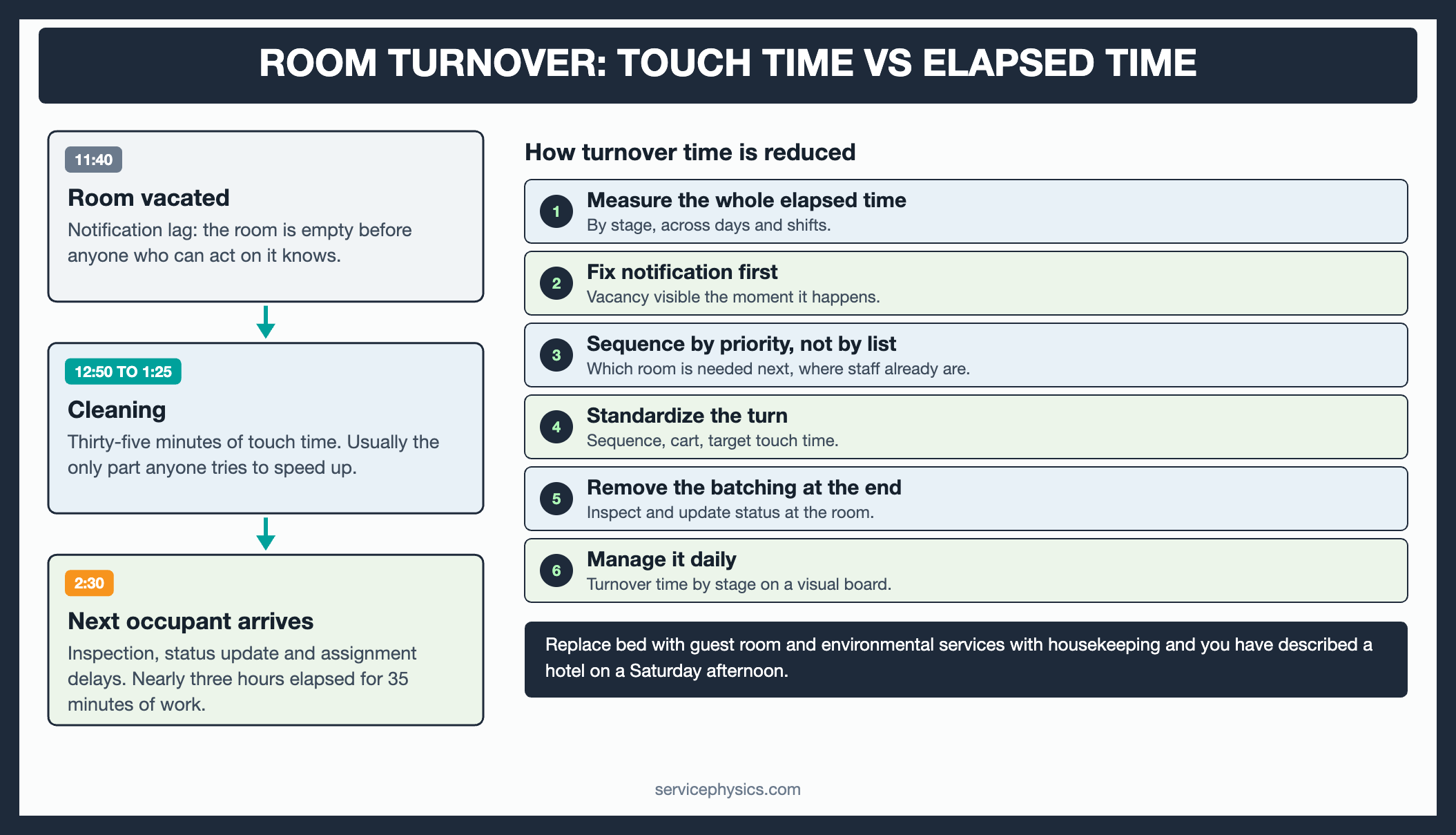
A hospital bed is vacated at 11:40am. Environmental services is notified at 12:25pm, arrives at 12:50pm, finishes at 1:25pm, and the bed is marked clean in the system at 1:50pm when someone gets back to a workstation. The next patient, who has been boarding in the emergency department since 8am, arrives on the unit at 2:30pm. Elapsed time: nearly three hours. Time spent cleaning: thirty-five minutes.
Replace “bed” with “guest room,” “environmental services” with “housekeeping,” and “emergency department” with “lobby,” and you have described a hotel on a Saturday afternoon. The industries are different. The operations problem is identical.
What Is Room Turnover Time?
Room turnover time is the total elapsed time between one occupant leaving a room and the next occupant being able to use it. It includes the notification that the room is empty, any queue before work begins, the cleaning and preparation itself, inspection, the status update that makes the room available, and the assignment of the next occupant. In hospitals it is often called bed turnover or bed turnaround; in hotels it is room turn or room readiness.
The distinction that matters is between touch time and elapsed time. Touch time is the minutes someone is actually working in the room. Elapsed time is what the next occupant experiences. In most operations, touch time is a minority of the total, and the rest is waiting, communication lag, and unclear ownership.
Turnover time is a capacity metric. A hospital that cuts average turnover by an hour across 300 beds has created the equivalent of a dozen new beds. A hotel that reliably has rooms ready at check-in time sells more early check-ins, takes fewer complaints, and runs a calmer lobby.
Why It Matters in Both Industries
In a hospital, turnover delays sit directly in the middle of patient flow. A slow turn keeps an admitted patient boarding in the ED, delays a post-surgical transfer, and can cascade into cancelled procedures. Because bed capacity is fixed and expensive, turnover is one of the few levers that creates capacity without construction.
In a hotel, turnover determines whether the property can honor check-in times, sell early arrivals and late departures, and absorb same-day bookings. Late rooms create lobby queues, front desk stress, and the first bad impression of a stay. On high-occupancy days, the housekeeping schedule is the operation.
In both cases, turnover is usually treated as a departmental efficiency problem, owned by environmental services or housekeeping. It is really a cross-functional flow problem, and that is why it rarely improves when only the cleaning step is targeted.
Where the Minutes Actually Go
When we observe turnover with a stopwatch, the same five delays appear in both industries.
Notification lag
The room is empty before anyone who can act on it knows. Discharge paperwork is signed but the bed is not marked vacant; the guest checks out at a kiosk but housekeeping learns at the next radio call.
Queueing and travel
Staff are assigned rooms in a fixed sequence rather than by urgency and proximity, so the room that matters most waits while rooms that do not are cleaned first.
Missing supplies and equipment
The cart is short on linen, the room needs a piece of equipment that is elsewhere, or a repair is discovered mid-turn. Each one is a trip and a wait.
Inspection and status update delay
The room is clean but not yet marked clean, because inspection is batched or the status update happens at a workstation later.
Assignment delay
The room is available but nobody has matched the waiting patient or guest to it, because bed management or the front desk is working from stale information.
How Turnover Time Is Reduced
The Service Physics approach is the same one we use for any throughput problem, adapted for the setting.
1. Measure the whole elapsed time
Time every turnover from vacancy to next occupant, broken into stages, across days and shifts. The stage breakdown is what shows that cleaning is rarely the constraint.
2. Fix notification first
Make room vacancy visible to the people who act on it at the moment it happens, whether through a bed management board, a housekeeping app, or a simple standard that the person releasing the room updates the status before doing anything else.
3. Sequence by priority, not by list
Assign rooms by which are needed next and where staff already are. A priority queue driven by demand (the admissions waiting, the arrivals due) outperforms a fixed route every time.
4. Standardize the turn
Define the standard sequence for a clean, the supplies on the cart, and the target touch time. Standard work makes the process teachable, measurable, and improvable, and it protects quality when the pressure is on.
5. Remove the batching at the end
Inspect and update status at the room, immediately. Batched inspections and delayed updates can add thirty to sixty minutes to a room that was ready long ago.
6. Manage it daily
Track turnover time by stage on a visual board and review it in a short daily huddle. Turnover degrades quietly; daily management is what keeps it from drifting back.
What Hospitals and Hotels Can Learn from Each Other
Hotels tend to be further ahead on sequencing and real-time status because occupancy is so visible in revenue. Hospitals tend to be further ahead on standardized cleaning protocols because infection control demands it. Each has something to borrow.
The deeper lesson is that the constraint in a service operation is almost never the visible work. It is the handoffs, waits, and information gaps around it. That is as true of a hotel floor, a hospital unit, or a restaurant kitchen line. Recognizing the pattern is what lets an operations team move between industries and still find the capacity.
Frequently Asked Questions
What is a good room turnover time?
It depends on the setting and the standard of clean required, so a target should be set from observed touch time plus a small allowance rather than from a benchmark. The more useful question is how much of your elapsed time is not touch time. If cleaning takes thirty-five minutes and turnover takes three hours, the target is the two hours and twenty-five minutes of waiting.
Does reducing turnover time compromise cleaning quality?
Not when the reduction comes from removing waits, lag, and batching around the clean rather than from rushing the clean itself. Standardizing the cleaning sequence usually improves quality, because every room gets the same steps in the same order and the standard can be audited.
Do you need bed management or housekeeping software to improve turnover?
No. The largest gains usually come from notification standards, priority sequencing, and immediate status updates, which can be run on a whiteboard and a radio. Software helps once the process is designed. Applied to an undesigned process, it tends to record the delays rather than remove them.
Related Reading
Room turnover is one stage of patient flow in a hospital and a central part of the service delivery system in a hotel. The observation method is described in our guide to time and motion studies, and the routines that hold the gains in what is a management system.
Create Capacity from the Rooms You Already Have
Service Physics helps hospitals, hotels, and multi-unit service brands find the capacity trapped in handoffs and waits. See our work in healthcare and across multi-unit service brands, or book a strategy call.

Insights in your inbox
Stay ahead of what’s next in service operations. Sign up for the Service Physics mailing list to get our exclusive insights in your inbox.