
How Time and Motion Studies Work in a Hospital or Clinic

Ask a nurse manager how much of a nurse’s shift is spent at the bedside and the answer is usually a guess somewhere between half and two-thirds. Ask the nurses and they will say less. Measure it, and on many medical-surgical units the figure lands closer to a third. The rest goes to walking, searching for supplies and equipment, documentation, waiting on others, and hunting for information that should have been in one place.
That gap between what leaders assume and what actually happens is the reason time and motion studies exist. In healthcare they are not about speeding clinicians up. They are about finding the work that should not be there at all.
What Is a Time and Motion Study in Healthcare?
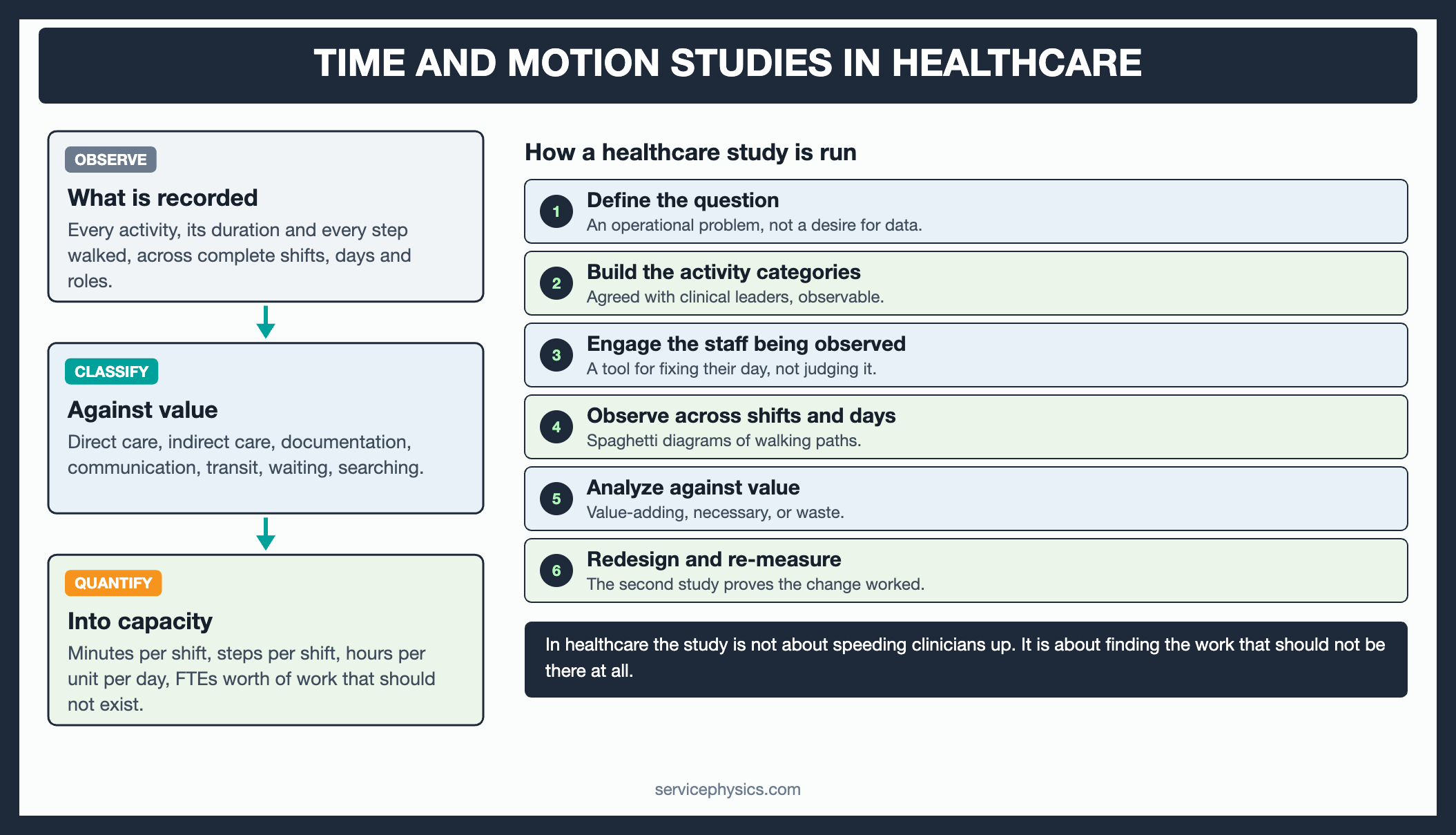
A time and motion study is a structured observation of how work is actually performed: which tasks are done, in what sequence, how long each takes, and how much movement is involved. In a hospital or clinic it means trained observers following nurses, providers, technicians, or support staff through real shifts, recording every activity and every step walked, and then analyzing the result against the value the patient receives.
The method dates to early industrial engineering and it is the foundation of lean operations, but the healthcare application has its own rules. Observation has to respect patient privacy and clinical judgment. Categories have to distinguish direct patient care from indirect care, documentation, communication, and waste. And the purpose has to be made explicit to the people being observed, because a study that feels like surveillance produces bad data and worse morale.
Done properly, the output is a fact base: a minute-by-minute account of a role, aggregated across enough shifts to be reliable, that shows exactly where capacity is lost.
Why Healthcare Organizations Use Them
Hospitals and clinics are staffed by expensive, scarce professionals doing work that is only partly clinical. Every minute a nurse spends looking for a working IV pump, a physician spends waiting for a room to be turned, or a medical assistant spends re-entering information is a minute of capacity the organization has paid for and not received.
Time and motion studies make that loss visible and quantifiable. They answer questions that otherwise get argued about: how much time is really lost to supply hunting, how far staff walk per shift, how long handoffs actually take, where documentation is duplicated, and whether a unit’s staffing model matches the work it is asked to do. They also settle the question of whether a problem is a people problem or a system problem, which it almost always is.
The results feed directly into decisions about layout, supply placement, role design, staffing by hour, technology, and standard work. Without the study, those decisions are made on anecdote. With it, they are made on evidence the clinical team collected alongside you.
How a Healthcare Time and Motion Study Is Run
The Service Physics approach adapts the industrial method to clinical environments in six steps.
1. Define the question
Start with the operational problem, not the desire for data. “Why does discharge take six hours from order to departure” is a study. “Let’s see what nurses do all day” is not. The question determines which roles, units, and shifts to observe.
2. Build the activity categories
Agree with clinical leaders on a category list that fits the role: direct care, indirect care, documentation, communication, transit, waiting, searching, and so on. Categories should be mutually exclusive and observable without interpretation.
3. Engage the staff being observed
Explain the purpose, the categories, and how the data will be used before the first observation. Invite frontline staff to review the categories. Observation works when the people observed see it as a tool for fixing their day rather than judging it.
4. Observe across shifts and days
Follow each role through complete shifts, on multiple days and across day, evening, and weekend patterns, recording activity, duration, and movement. Spaghetti diagrams that trace walking paths on a floor plan are often the single most persuasive output.
5. Analyze against value
Classify each activity as value-adding, necessary but non-value-adding, or waste. Quantify the waste in minutes per shift and steps per shift, then translate it into capacity: hours per unit per day, or the number of full-time equivalents worth of time being consumed by work that should not exist.
6. Redesign and re-measure
Use the findings to change supply placement, layouts, handoff standards, role boundaries, and staffing by hour. Then observe again. The second study is what proves the change worked and gives the team a result they can see.
What the Studies Typically Reveal
Patterns recur across organizations. Nurses walk several miles per shift, much of it to supply rooms, medication stations, and equipment that could be positioned closer to patients. Documentation is duplicated across systems and paper. Handoffs at shift change and between departments take far longer than anyone scheduled for them. Providers wait on rooms, on results, and on each other. Support roles are pulled into tasks well outside their design, while licensed staff do work that does not require a license.
None of that is a criticism of the people involved. It is the predictable result of systems that were never designed, only accumulated. The study is what makes the accumulation visible so it can be undone.
Common Mistakes
The most damaging mistake is running the study as a productivity audit. If staff believe the goal is to cut headcount, observation becomes adversarial and the data becomes theater. The second is observing too little: a single shift on a single unit produces an anecdote, not a baseline. A third is stopping at the report. A study that identifies four hours of waste per shift and leads to no layout, supply, or standard work changes has cost time and goodwill for nothing. And finally, many organizations skip the re-measurement, so they never learn whether the changes actually returned the capacity.
Frequently Asked Questions
How long does a healthcare time and motion study take?
Observation for a single unit or clinic typically runs two to four weeks to cover enough shifts, days, and roles for the results to be reliable, followed by analysis and a redesign phase. Larger studies across multiple units run longer but follow the same structure.
Are time and motion studies compatible with patient privacy rules?
Yes, when designed for it. Observers record activities and timings, not patient identities or clinical details. Observation protocols are reviewed with compliance and clinical leadership in advance, patients are informed where appropriate, and observers step out of any interaction where their presence is not welcome.
What is the difference between a time and motion study and a workflow analysis?
A workflow analysis maps the intended sequence of steps in a process, usually from interviews and documentation. A time and motion study measures what actually happens, with real durations and real movement, by direct observation. The two are complementary, but only the time and motion study tells you where the minutes go.
Related Reading
For the method in full, see our complete guide to time and motion studies. The results usually feed into a patient flow redesign and into how a service delivery system is built. The metric most organizations use to track the result is described in what is TPLH.
See Where the Time Actually Goes
Service Physics runs time and motion studies in hospitals, clinics, and service settings, and stays to redesign the work around what they reveal. Learn about our healthcare consulting or book a strategy call.

Insights in your inbox
Stay ahead of what’s next in service operations. Sign up for the Service Physics mailing list to get our exclusive insights in your inbox.