
What Is Daily Management in Healthcare? Huddles, Visual Boards, and Tiered Escalation

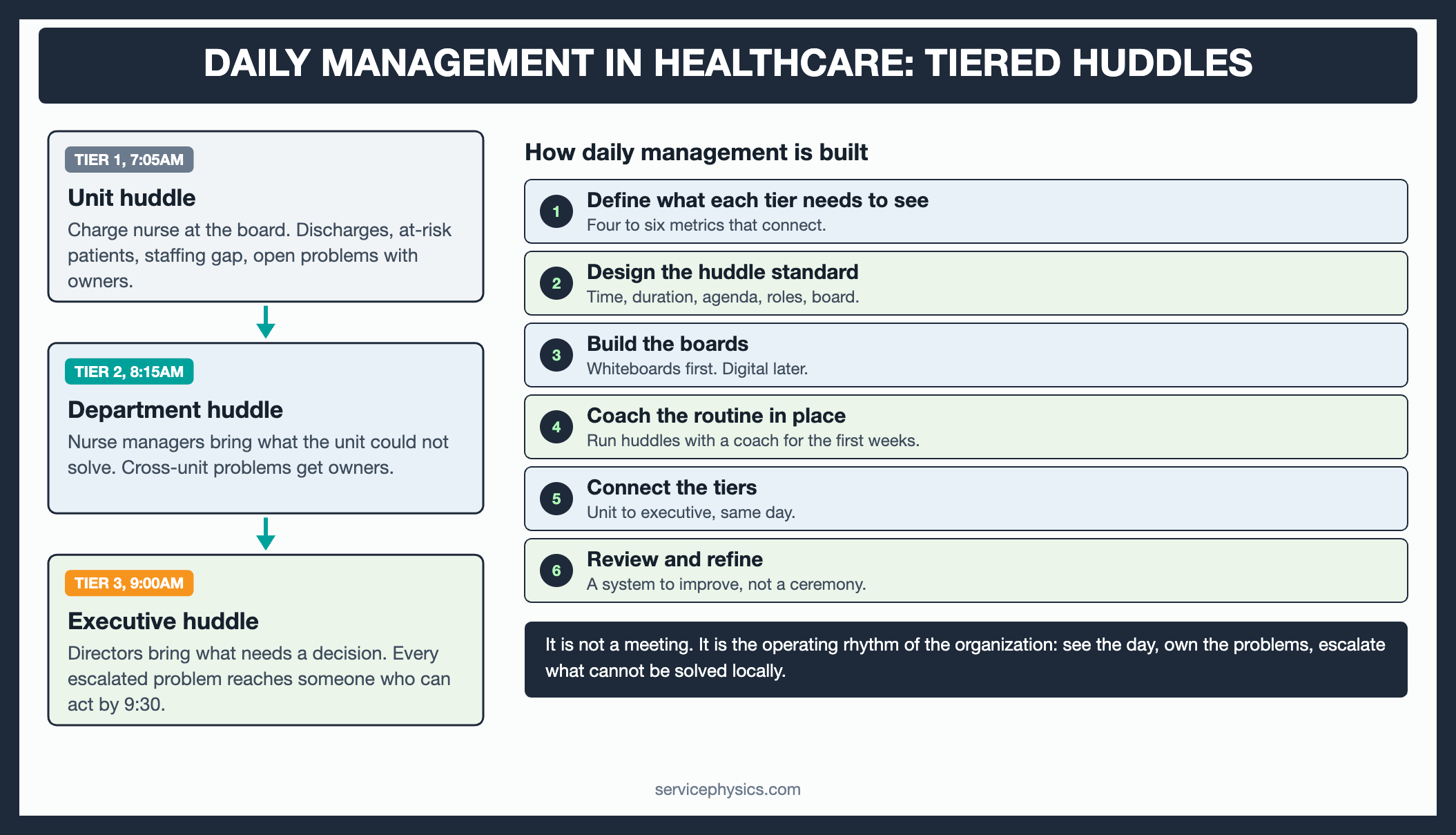
At 7:05am a charge nurse stands at a whiteboard with the incoming shift. In four minutes they cover the day’s expected discharges, the two patients at risk of deterioration, the staffing gap on the evening shift, and yesterday’s problem with the missing IV pumps, which has an owner and a due date. At 8:15am the nurse manager takes the pump problem and the staffing gap to a huddle with the other unit managers. At 9:00am the director takes the ones that need a decision to the executive huddle. By 9:30am, every problem in the building that needed escalation has reached someone who can act on it, and everyone knows what today is supposed to look like.
That is daily management. It is not a meeting. It is the operating rhythm of the organization.
What Is Daily Management in Healthcare?
Daily management is a structured system of short, standardized routines that leaders at every level use to run the operation each day: to see performance, surface problems, escalate what cannot be solved locally, and follow through on what was promised. Its core components are tiered huddles, visual management boards, a standard set of metrics, and defined leader standard work. In healthcare it is sometimes called a lean management system, a daily management system, or tiered huddles.
The idea comes from the Toyota Production System, where daily management is the mechanism that connects frontline problems to leadership decisions within hours rather than months. In a hospital or clinic it plays the same role, connecting a unit’s 7am huddle to the executive team’s 9am huddle through a tiered chain, so that a supply problem, a staffing gap, or a safety concern moves to the right level the same day.
Daily management is what a management system looks like in practice. The system defines roles, routines, metrics, and principles; daily management is the daily execution of them.
Why It Matters
Healthcare organizations are full of improvement work that does not stick. Projects succeed, the team moves on, and within a quarter the unit has drifted back. The usual reason is that there was no daily mechanism to notice the drift and correct it. Daily management is that mechanism.
It also changes how problems travel. Without it, a frontline problem either gets worked around, escalated through email and lost, or waits for a monthly meeting. With tiered huddles, it is visible on a board by 7am, owned by someone by 7:10, and in front of a director by 9 if it needs to be. The organization gets faster at solving small problems before they become large ones.
And it aligns levels. When the unit, the department, and the executive team are looking at the same few metrics on the same cadence, the goals set at the top and the work done at the bottom finally point in the same direction.
The Components of Daily Management
Tiered huddles
Short stand-up meetings, usually five to fifteen minutes, held at fixed times each day at each level of the organization, with each tier feeding the next. Tier 1 is the unit or department, Tier 2 is the service line or division, Tier 3 is the executive team. Each huddle has a standard agenda: safety, quality, flow, staffing, and open problems.
Visual management boards
A physical or digital board at each tier showing the metrics that matter, today’s plan, and the problem list with owners and dates. The board makes performance visible to everyone on the unit, not just the manager, and it makes the huddle run itself.
A standard set of metrics
A small number of measures, typically four to six, that are tracked daily and roll up through the tiers. In a hospital they often include discharges before noon, ED boarding hours, falls or safety events, staffing to demand, and open problem count.
Leader standard work
The routines a leader follows every day and week: when they huddle, when they walk the unit, what they look at, who they check in with. Standard work turns leadership from a personality into a practice.
Problem escalation and follow-through
A defined path for what happens when a problem cannot be solved at its tier, and a visible record of who owns it and when it is due. Follow-through is what gives the frontline a reason to keep raising problems.
How Daily Management Is Built
Service Physics builds daily management as part of management system design, with the leaders who will run it rather than for them.
1. Define what each tier needs to see
Agree the few metrics and the daily questions at each level. What a charge nurse needs at 7am is different from what a COO needs at 9am, but they have to connect.
2. Design the huddle standard
Set the time, duration, agenda, roles, and board layout for each tier. Keep it short enough that it will actually happen every day, including weekends.
3. Build the boards
Start with whiteboards. They are fast to change, visible to everyone, and force the team to decide what matters. Digital boards come later, once the content has stabilized.
4. Coach the routine in place
Leaders learn daily management by running huddles with a coach beside them for the first weeks, not by attending a class. The coaching focuses on asking questions, keeping to time, and closing problems.
5. Connect the tiers
Run the full chain, unit to executive, and fix the gaps where problems fall through. The first time an executive resolves a frontline problem the same day, the system becomes real to the organization.
6. Review and refine
After a few weeks, review what the huddles are surfacing and what they are not, and adjust metrics, agendas, and timing. Daily management is a system to improve, not a ceremony to preserve.
Common Mistakes
The most common failure is turning the huddle into a status report. If leaders read numbers aloud and nobody owns a problem, attendance will decay within a month. The second is too many metrics. A board with twenty measures is a board nobody reads. A third is running only Tier 1 huddles without connecting them upward, so frontline problems surface daily and go nowhere, which is worse than not surfacing them at all. And the most damaging is inconsistent leadership participation. If directors skip the Tier 2 huddle when they are busy, managers learn that daily management is optional.
Frequently Asked Questions
How long should a daily huddle be?
Five to fifteen minutes, standing, at the board. A unit huddle should be closer to five; an executive huddle may run fifteen. If a huddle regularly exceeds its time, the agenda is too broad or problems are being solved in the huddle rather than assigned from it.
What is the difference between daily management and a lean management system?
A lean management system is the full set of leadership routines, roles, metrics, and principles an organization uses to run and improve its operation. Daily management is the daily cadence within it: the huddles, boards, and escalation that happen every day. Most organizations start with daily management because it is concrete and produces results quickly.
Does daily management work in outpatient clinics as well as hospitals?
Yes, and often faster, because clinics are smaller and the tiers are shorter. A clinic might run a single morning huddle covering schedule, staffing, supplies, and open problems, feeding a weekly practice-level review. The principles are the same: see the day, own the problems, escalate what cannot be solved locally.
Related Reading
Daily management is the operating layer of a management system. The problem-solving method that runs through it is A3 problem solving, and the flow metrics it typically tracks are explained in what is patient flow.
Build a Rhythm Your Leaders Will Actually Keep
Service Physics designs daily management systems with healthcare leaders, in the field, so improvements hold and problems move. Learn about our healthcare consulting or book a strategy call.

Insights in your inbox
Stay ahead of what’s next in service operations. Sign up for the Service Physics mailing list to get our exclusive insights in your inbox.