
What Is Digital Strategy for Service Operations? Turning Data into Decisions on the Floor

A multi-unit restaurant brand has a POS system, a labor scheduling platform, a loyalty app, a delivery aggregator dashboard, an inventory tool, and a business intelligence layer that was supposed to tie them all together. The operations team still builds its weekly review in a spreadsheet, by hand, from four exports. The data is all there. None of it is changing what happens on a Tuesday lunch shift.
That is the gap a digital strategy is meant to close. Not the gap between having data and having more data, but the gap between having data and using it.
What Is Digital Strategy?
Digital strategy is the plan for how a business uses data, technology, and automation to achieve its goals. For a service operation, that means deciding which data matters, how it gets collected and connected, who sees it, what decisions it should drive, and which manual processes should be automated so people can spend their time on the work that needs them.
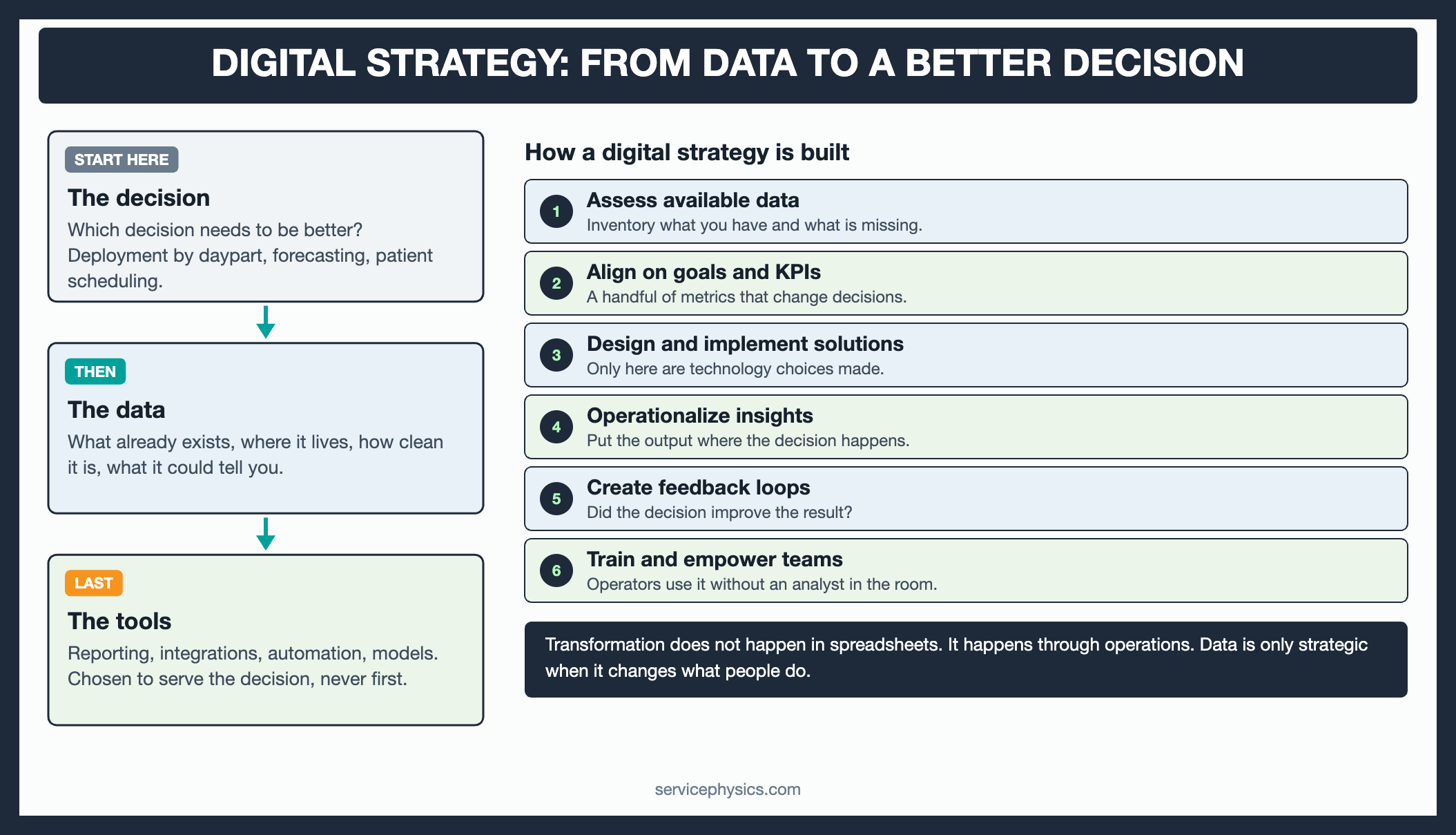
It is easy to confuse digital strategy with a technology roadmap or a list of software purchases. It is neither. A digital strategy starts with the business problem and the decision that needs to be better, then works backward to the data and tools required. The software is the last decision, not the first.
In a service business, the test of a digital strategy is simple: does a general manager, a nurse manager, or a district leader make a better decision this week because of it?
Why Digital Strategy Matters in Service Operations
Service brands generate enormous amounts of operational data and typically use a small fraction of it. Transaction timestamps, labor punches, order modifications, wait times, patient scheduling, and loyalty engagement all contain signals about where capacity is lost and where demand is heading. Left unconnected, they are just storage costs.
The common failure modes are recognizable. Decisions are made on instinct because the data is too hard to reach. Teams spend hours on manual reporting and reconciliation. Systems do not talk to each other, so nobody has a single view of the operation. Infrastructure that worked at 50 locations cannot keep up at 500.
A well-built digital strategy turns those liabilities into an advantage: decisions grounded in analytics, workflows automated where they should be, and a data foundation that scales with the business rather than against it.
How a Digital Strategy Is Built
At Service Physics, digital strategy is an operations discipline first and a technology discipline second. Our method has six steps.
1. Assess available data
Inventory what data exists, where it lives, how clean it is, and what it could tell you. Most brands discover valuable data they did not know they had, and gaps they assumed were covered.
2. Align on goals and KPIs
Define the business outcomes the strategy serves and the handful of metrics that will show progress. If a metric will not change a decision, it does not belong in the strategy.
3. Design and implement digital solutions
Build the reporting, integrations, automations, or models that connect data to the decisions identified in step two. This is where technology choices are made, and only here.
4. Operationalize insights
Put the output where the decision happens: in the pre-shift huddle, the district manager’s visit routine, the scheduling workflow. An insight that lives in a dashboard nobody opens is not operationalized.
5. Create feedback loops
Track whether the decisions driven by the data actually improved the results, and refine the models, thresholds, and reports accordingly. Digital strategy is iterative or it is obsolete.
6. Train and empower teams
Teach frontline and field leaders to read and act on the data. The strategy only scales when the people closest to the work can use it without an analyst in the room.
Common Mistakes in Digital Strategy
The biggest mistake is starting with the platform. Brands buy a BI tool or an AI product and then look for problems it might solve, which reliably produces expensive dashboards and no change in operations. The second is treating digital strategy as an IT project. If operations leaders are not designing the decisions the data should drive, the result will be technically correct and operationally irrelevant.
A third mistake is over-scoping. Trying to unify every data source at once delays value by years. Start with the two or three data connections that support the most important decisions. And finally, many brands skip the feedback loop, so a forecast or model that drifts out of accuracy keeps driving decisions long after it stopped being right.
What It Looks Like in the Field
In foodservice, digital strategy often means using transaction and labor data to optimize deployment by daypart, predictive demand forecasting to reduce food waste and stockouts, and redesigning ordering flows using data from digital and mobile channels so that new revenue does not degrade in-store service.
In healthcare, it means patient flow and scheduling optimization built on real appointment and throughput data, automated compliance and quality tracking so that clinical teams are not doing manual audits, and operational efficiency gains from automating administrative workflows.
The principle in every case is the one we repeat often: transformation does not happen in spreadsheets, it happens through operations. Data is only strategic when it changes what people do.
Frequently Asked Questions
What is the difference between digital strategy and digital transformation?
Digital transformation usually describes a broad, company-wide change in how a business operates using technology. Digital strategy is the specific plan that directs that change: which problems to solve, which data to use, which decisions to improve, and in what order. A transformation without a strategy tends to become a series of disconnected software rollouts.
Does a service brand need a data team to have a digital strategy?
Not to begin. Most early value comes from connecting data that already exists and putting it in front of operators in a usable form. A dedicated analytics function becomes valuable later, once the strategy has proven which decisions benefit most from deeper modeling.
How does AI fit into a digital strategy for operations?
AI is one tool among several, and it is most useful for forecasting, anomaly detection, and automating repetitive analysis. It is only as good as the operational data feeding it and the decision process consuming its output. A digital strategy should define the decision first and then ask whether AI improves it, rather than the reverse.
Related Reading
Digital strategy is most powerful when paired with a clear operations strategy and metrics like TPLH. For the on-the-ground measurement that grounds good data, see our guide to time and motion studies.
Turn Your Data into Action
Service Physics helps multi-unit service brands turn raw data into decisions their teams can act on, and implements alongside you rather than handing over a deck. Learn more about Digital Strategy Design or book a strategy call.

Insights in your inbox
Stay ahead of what’s next in service operations. Sign up for the Service Physics mailing list to get our exclusive insights in your inbox.