
What Is Customer Experience Design? Building Service That Feels the Same at Every Location

A guest orders on the app, arrives to find the mobile pickup shelf empty, asks the cashier, gets pointed to the drive-thru window, and is finally handed a cold order by someone who apologizes for a problem they did not cause. Every person in that chain did their job. The experience was still broken, because nobody designed the handoffs between them.
Customer experience is not produced by friendly people. It is produced by systems that let friendly people succeed. Customer experience design is the discipline of building those systems.
What Is Customer Experience Design?
Customer experience design is the practice of deliberately shaping every interaction a customer has with a brand, from the first touchpoint to the last, so that the experience is consistent, operationally achievable, and aligned with what the brand promises. It covers the customer journey, the service workflows and roles behind each step of it, the behaviors expected of frontline teams, and the way all of that adapts across channels and volumes.
The term is sometimes used to describe purely creative or branding work, such as store design or messaging. That is a part of it. But in a multi-unit service business the more important half is operational: what has to be true about staffing, flow, standards, and training for the intended experience to actually happen on a Saturday at peak.
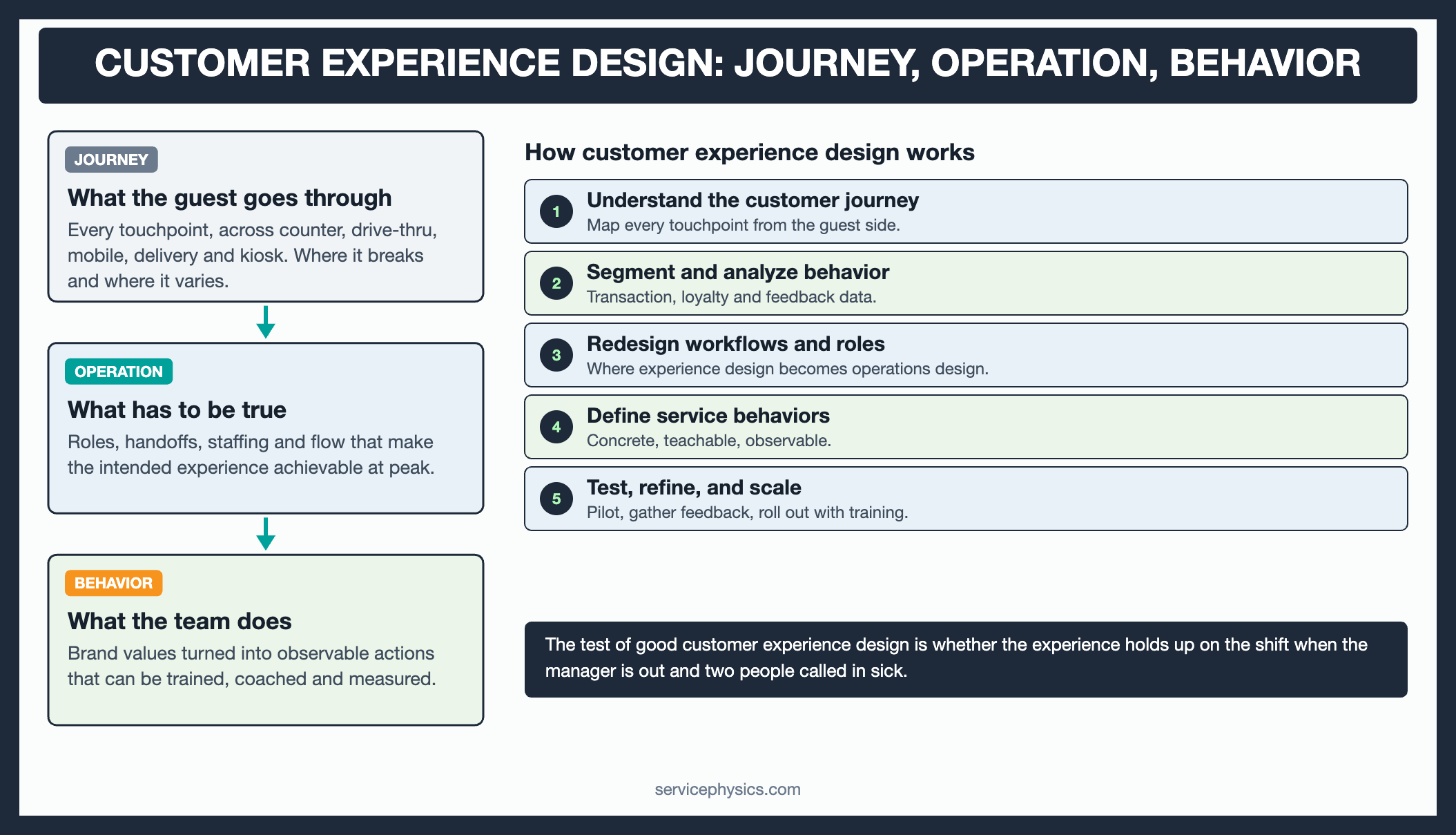
The test of good customer experience design is whether the experience holds up on the shift when the manager is out and two people called in sick.
Why Customer Experience Design Matters
Multi-unit brands compete on consistency. A guest who has a great experience at one location and a poor one at the next does not average the two; they remember the poor one. As channels multiply, with counter, drive-thru, mobile, delivery, and kiosk all serving the same guests, the opportunities for inconsistency multiply with them.
The usual symptoms are inconsistent service delivery across locations and channels, service models too rigid to adapt to different formats and volumes, gaps at the transitions between roles that leave guests confused, and teams whose priorities are not aligned around what customers actually value.
Designing the experience addresses these at the root. It sets a repeatable expectation, builds the workflows that make it achievable, and embeds the standards in daily work so frontline teams can deliver without heroics.
How Customer Experience Design Works
At Service Physics, customer experience design connects what guests value to how work is done. The method has five steps.
1. Understand the customer journey
Map every touchpoint from the customer’s point of view, across every channel. Identify where the experience breaks, where it is inconsistent, and where it creates friction the customer notices but the operation does not.
2. Segment and analyze customer behavior
Use transaction, loyalty, and feedback data to understand which customers do what, and what they value. Different segments experience the same journey differently, and the design should reflect that.
3. Redesign service workflows and roles
Rebuild the operational steps behind each touchpoint: who is responsible, how handoffs work, how the flow adapts when volume changes. This is where experience design becomes operations design.
4. Define service behaviors
Specify the behaviors that express the brand at each touchpoint in concrete, teachable terms. Vague values like “warmth” become observable actions that can be trained, coached, and measured.
5. Test, refine, and scale
Pilot the redesigned experience in real locations, gather feedback from guests and teams, adjust, and then roll out with the training and management routines needed to sustain it.
Common Mistakes in Customer Experience Design
The first mistake is designing the experience without designing the operation. A beautiful journey map with no changes to roles, flow, or staffing produces a training video and no change on the floor. The second is designing for one channel. Brands that perfect the dine-in experience and bolt on mobile and delivery afterward end up with a great experience for a shrinking share of their guests.
A third mistake is treating behavior standards as posters. Values on a wall do not change service; defined, coached, and reinforced behaviors do. And finally, many brands design for average volume and average staffing. The experience has to be designed for the conditions under which it is most likely to fail.
What It Looks Like in the Field
In foodservice, customer experience design means building consistency across counter, drive-thru, mobile, and dine-in so a guest gets the same brand regardless of how they order, streamlining the guest journey by fixing the friction points that data and observation reveal, and training brand-aligned behaviors at the frontline in a way teams can actually execute at peak.
In healthcare, it means simplifying patient care touchpoints from scheduling to discharge, improving communication between clinical and operational teams so patients are not caught between them, and delivering consistent, empathetic care across every site and every shift.
When the operation is designed to support the experience, the experience stops depending on luck. That is how Service Physics helped Peet’s Coffee improve throughput and unlock a 57 percent increase in retail store capacity while making the work easier for the teams delivering it.
Related reading: What Is Customer Loyalty Program Design, What Is a Service Delivery System and What Is Digital Strategy for Service Operations.
Frequently Asked Questions
What is the difference between customer experience design and customer service?
Customer service is what happens in an individual interaction, usually when something needs attention. Customer experience design is the deliberate engineering of the whole journey, including the workflows, roles, and behaviors that determine how those interactions go. Good design reduces the need for recovery-style customer service in the first place.
How is customer experience design different from UX design?
UX design typically focuses on digital products such as apps and websites. Customer experience design covers the full journey across physical and digital channels, and in a service business it extends into operations: staffing, flow, standards, and training. The app is one touchpoint among many.
How do you measure whether customer experience design worked?
By pairing customer measures with operational ones. Guest satisfaction, repeat visit rates, and complaint volume show the customer side. Service times, order accuracy, and consistency between locations show whether the operation is delivering the designed experience. Improvement in one without the other usually means the design has not fully landed.
Related Reading
Customer experience design sits on top of a well-designed service delivery system and often extends into loyalty program design. The tools used to find friction in the journey are covered in our guides to value stream mapping and time and motion studies.
Deliver an Experience That Is Consistent, Scalable, and Built to Last
Service Physics designs customer experiences that are operationally sound and behaviorally consistent, then helps your teams deliver them at every location. Learn more about Customer Experience Design or book a strategy call.

Insights in your inbox
Stay ahead of what’s next in service operations. Sign up for the Service Physics mailing list to get our exclusive insights in your inbox.