
What Is Customer Loyalty Program Design? Building Programs That Change Behavior, Not Just Margins
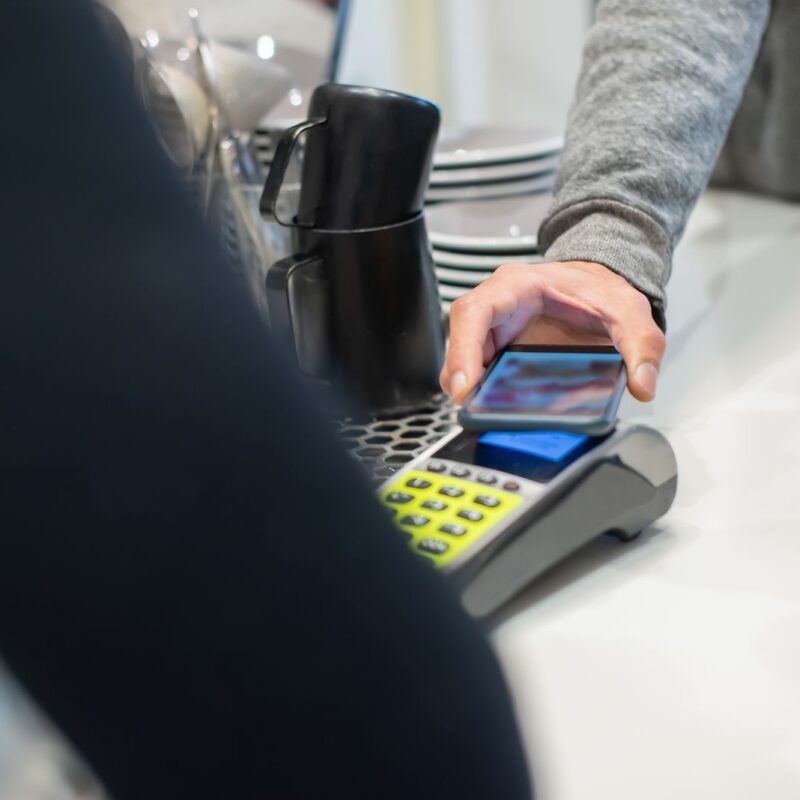
A fast casual brand launches a loyalty app. Sign-ups are strong. Within a year, most active members are guests who were already visiting weekly, now paying ten percent less. At the register, cashiers spend an extra twenty seconds per transaction explaining how to redeem. Finance sees margin erosion, operations sees slower lines, and marketing sees a growing member count. Everyone is right, and the program is failing.
The program was launched, but it was never designed. That distinction is what customer loyalty program design is about.
What Is Customer Loyalty Program Design?
Customer loyalty program design is the practice of structuring a rewards or engagement program so that it changes customer behavior in ways that create business value, while fitting cleanly into how the operation actually runs. It covers the program’s structure (visit-based, spend-based, tiered, or hybrid), the rewards and how they are earned, the segmentation and data that inform offers, the engagement mechanics that keep members active, and the frontline workflows that make redemption fast and simple.
The phrase we use at Service Physics is “minds before wallets.” A well-designed program earns a place in the guest’s habits first. Discounts are one tool, and usually the most expensive one. Frequency, visit value, and brand connection are the outcomes the design should be built around.
Loyalty program design is therefore as much an operations and data discipline as a marketing one. A program that slows the line or confuses the team is a badly designed program no matter how many members it has.
Why Loyalty Program Design Matters
Most loyalty programs start with promise and drift into being a discount channel. The reasons are structural. Programs are often designed by marketing and a vendor, with operations consulted late and finance consulted after the fact. Offers are set by intuition rather than data. Redemption is layered onto a register workflow that was never built for it.
The results are consistent across brands: frontline complexity that slows service at peak, fragmented guest experiences across mobile, in-store, and digital channels, program structures that reward spend that would have happened anyway, and low engagement with no clear return on investment.
Deliberate design addresses each of these. It starts from guest behavior and business goals, builds the reward structure to move specific metrics, and embeds the program into operations and training so that it runs without friction.
How Loyalty Program Design Works
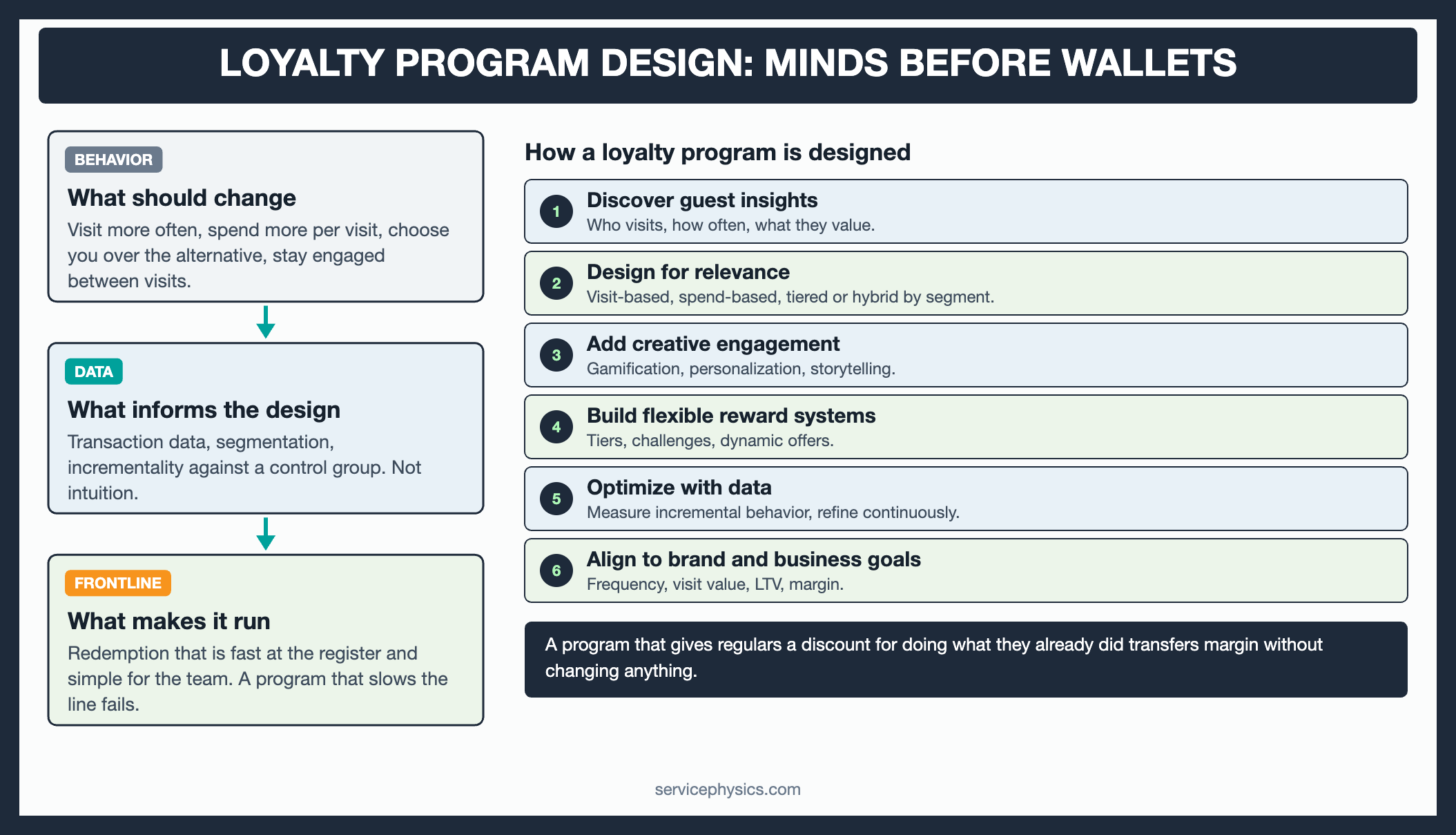
The Service Physics method has six steps, and it is grounded in data at every one.
1. Discover guest insights
Use transaction data, existing loyalty metrics, and segmentation models to understand who your guests are, how often they visit, what they buy, and what they value. Design decisions follow from this picture, not from assumptions about it.
2. Design for relevance
Choose the program structure that fits each segment: visit-based programs for frequency, spend-based for basket size, hybrid or tiered models where both matter. Relevance to the guest is what drives participation.
3. Add creative engagement
Layer in gamification, personalization, and brand storytelling so participation is enjoyable rather than transactional. Engagement mechanics are what keep a member active between visits.
4. Build flexible reward systems
Use tiers, challenges, and dynamic offers so the program can respond to behavior over time and stay fresh. Static point schemes decay; behavior-driven systems adapt.
5. Optimize with data
Track engagement and redemption, measure incremental behavior against a control, and refine offers, messaging, and mechanics continuously. The program is a system to improve, not a campaign to launch.
6. Align to brand and business goals
Make sure the program supports the broader customer experience strategy and moves the metrics leadership cares about: frequency, visit value, lifetime value, and margin. A program that grows membership while shrinking margin has failed at this step.
Common Mistakes in Loyalty Program Design
The most common mistake is rewarding existing behavior. A program that gives regulars a discount for doing what they already did transfers margin without changing anything. The second is ignoring the frontline. If redemption takes twenty seconds at a register that is already the bottleneck, the program costs throughput at exactly the moments that matter most.
A third mistake is designing a single program for every guest. Segments differ in frequency, spend, and motivation, and a one-size structure will be irrelevant to most of them. And finally, many brands never measure incrementality. Without a control group, member spend growth is indistinguishable from the behavior of guests who would have joined anyway.
What It Looks Like in the Field
In foodservice, loyalty program design means simplifying redemption at the register so offers and workflows do not slow service or confuse teams, driving repeat visits with structured campaigns such as third-visit rewards or limited-time-offer tie-ins, and turning loyalty data into guest insight that personalizes offers to drive spend and lifetime value.
In healthcare, the same principles apply to patient engagement: visit-based programs built around care milestones to motivate preventive care and follow-ups, data feedback loops that reveal gaps in care and populations at risk of disengaging, and digital touchpoints through portals, apps, or text that keep patients connected between visits and make rescheduling simple.
In every case the program is built for behavior, grounded in data, and embedded in frontline execution, because a program the team cannot support is a program guests will not use.
Related reading: What Is Customer Experience Design, What Is Digital Strategy for Service Operations and What Is TPLH (Transactions per Labor Hour).
Frequently Asked Questions
What is the difference between a loyalty program and a rewards program?
A rewards program gives customers something in exchange for a purchase. A loyalty program is designed to change behavior over time: visit more often, spend more per visit, choose you over an alternative, and stay engaged between visits. Rewards are a component of most loyalty programs, but a program that only rewards is usually just a discount with extra steps.
How do you measure the ROI of a loyalty program?
By measuring incremental behavior, not member totals. Compare the frequency, spend, and retention of members against a comparable non-member group or a holdout, and net the cost of rewards and operational impact against the lift. Membership growth and redemption volume are activity metrics, not return metrics.
Should a loyalty program be visit-based or spend-based?
It depends on the behavior you want to change and on the segment. Visit-based programs are effective for driving frequency in high-frequency categories like coffee and quick service. Spend-based programs suit categories where basket size varies widely. Many brands use a hybrid or tiered structure so that different segments are motivated by the mechanic that matters to them.
Related Reading
Loyalty program design is an extension of customer experience design and depends on a solid digital strategy for the data behind it. For the operational side, see how a service delivery system keeps redemption from slowing the line.
Turn Loyalty into a Durable Advantage
Service Physics designs loyalty programs that are built for real-world execution, grounded in guest behavior, and aligned with long-term business outcomes. Learn more about Customer Loyalty Program Design or book a strategy call.

Insights in your inbox
Stay ahead of what’s next in service operations. Sign up for the Service Physics mailing list to get our exclusive insights in your inbox.