
What Is Program Management? How Service Brands Get Initiatives from Pilot to Every Location

A new service model tests brilliantly in five restaurants. Speed improves, labor drops, guests notice. Leadership approves a national rollout. Eighteen months later, about a third of locations are running it, another third are running something that resembles it, and the rest never started. The pilot worked. The program did not.
This pattern repeats in nearly every multi-unit service business, and it is rarely because the idea was wrong. It is because getting a change from a handful of locations to hundreds is a discipline of its own. That discipline is program management.
What Is Program Management?
Program management is the coordinated management of a group of related projects and activities to achieve an outcome that none of them could deliver alone. Where a project has a defined start, end, and deliverable, a program is about the result: a new service model running in every location, a new technology adopted by every team, a new standard sustained across a whole system.
In multi-unit operations, program management covers the whole arc of an initiative. It includes proving the idea in pilot, validating it with metrics, coordinating the functions that have to change for it to scale, managing risk and resources through rollout, tracking performance rigorously, and planning for how the change will be sustained after the launch team moves on.
The distinction from project management matters. A project manager keeps a workstream on schedule. A program manager keeps the outcome on track across many workstreams, many stakeholders, and a long enough timeline that priorities will shift along the way.
Why Program Management Matters in Service Operations
Service brands are good at generating initiatives and less good at finishing them. A typical field organization is asked to absorb new menu launches, technology changes, labor model updates, training programs, and marketing campaigns at the same time, often from different corporate teams that have not coordinated with each other.
The result is the set of problems every operator recognizes: rollouts that slow or stall, cross-functional misalignment where operations, training, marketing, and IT are each on a different timeline, limited field traction because store teams cannot tell which of this quarter’s initiatives actually matters, and competing priorities with no clear owner.
Program management is the structure that turns that disconnected effort into coordinated momentum. It sequences the work, gives it a single point of accountability, and keeps the field’s attention on the few things that will move results.
How Program Management Works
The Service Physics approach embeds with client teams rather than overseeing from a distance. It has seven components.
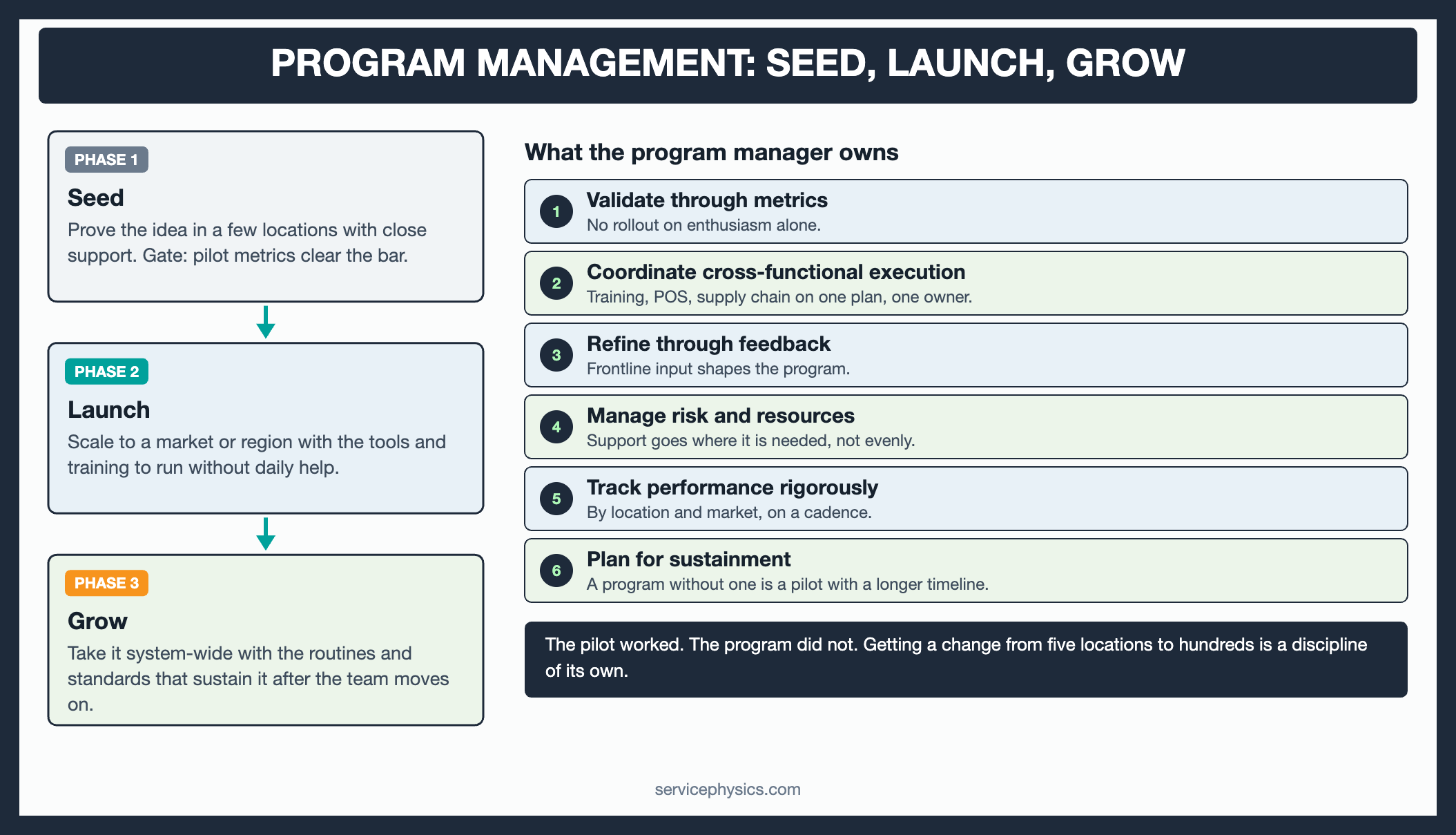
1. Start with Seed, Launch, Grow
Every program moves through three phases. Seed proves the idea in a small number of locations. Launch scales it to a market or region with support in place. Grow takes it system-wide with the tools and routines needed to sustain it. Each phase has its own success criteria and its own gate.
2. Validate through metrics
Define the measures that show the program is working before it scales, and hold the gate until the pilot data clears them. Rolling out on enthusiasm rather than evidence is how programs lose credibility.
3. Coordinate cross-functional execution
Map every function that has to change for the program to work, from training content to POS configuration to supply chain, and run them on one integrated plan with one owner.
4. Refine through feedback
Collect structured feedback from frontline teams at each phase and change the program in response. Field input is what turns a headquarters idea into something operators will actually run.
5. Manage risk and resources
Identify what could stall the rollout, from staffing gaps to competing initiatives, and plan around it. Allocate support to the locations and markets that need it most rather than evenly.
6. Track performance rigorously
Report progress against the program’s metrics on a regular cadence, by location and by market, so problems are visible early and leadership can act on facts.
7. Plan for sustainment
Design how the change will be maintained after the rollout team steps back: the routines, standards, training, and management system elements that keep it in place. A program without a sustainment plan is a pilot with a longer timeline.
Common Mistakes in Program Management
The first mistake is scaling before validating. A pilot that “felt good” but was never measured produces a rollout with no baseline and no way to tell whether it is working. The second is running the program as a corporate project with the field as recipients. Programs that do not incorporate frontline feedback in the Seed phase pay for it in the Grow phase.
A third mistake is under-resourcing the middle. Launch is where most programs fail, because the pilot team is too small to support a region and the system-wide tools do not exist yet. And the most expensive mistake is ignoring sustainment. Many brands celebrate the rollout, reassign the team, and watch the change erode within two quarters.
What It Looks Like in the Field
In foodservice, program management typically covers multi-unit initiative rollouts such as new service models or equipment, franchise and field alignment so that operators understand the why and the how before they are asked to change, and operational scaling support that keeps stores stable while the change lands.
In healthcare, it means Seed, Launch, Grow implementation for clinical and operational changes, structured stakeholder engagement and risk mitigation across departments, and sustainment strategy development so improvements outlast the project team.
When Service Physics partnered with Peet’s Coffee to improve service workflows, the program moved from observation to pilot to scale, and delivered a 57 percent increase in retail store capacity and $12.9 million in new annual revenue potential. The result came from the rollout discipline as much as from the idea.
Related reading: What Is Operations Strategy, What Is a Management System and What Is Digital Strategy for Service Operations.
Frequently Asked Questions
What is the difference between program management and project management?
Project management delivers a defined output on a schedule and budget. Program management coordinates multiple related projects and activities to achieve a business outcome, over a longer horizon and across more stakeholders. In a service brand, launching a new service model in every location is a program; updating the training module for it is a project within that program.
What does Seed, Launch, Grow mean?
Seed, Launch, Grow is the three-phase structure Service Physics uses for rollouts. Seed proves the change in a few locations with close support. Launch scales it to a market with the tools and training needed to run it without daily help. Grow takes it system-wide and builds the routines that sustain it. Each phase has a gate that the metrics must clear before the next begins.
Why do so many operational rollouts fail?
Usually because the idea was validated but the rollout was not designed. Common causes are unmeasured pilots, functions changing on different timelines, too little support during regional launch, and no plan for sustaining the change once the project team moves on. Program management exists to address each of those.
Related Reading
Programs usually implement an operations strategy or a new service delivery system, and they are sustained through a management system. The problem-solving discipline inside a well-run program is covered in our guide to A3 problem solving.
Lead Programs That Deliver
Service Physics takes ownership of implementation alongside your teams, keeps momentum through rollout, and builds the sustainment plan before the launch. Learn more about Program Management or book a strategy call.

Insights in your inbox
Stay ahead of what’s next in service operations. Sign up for the Service Physics mailing list to get our exclusive insights in your inbox.