
What Is Top-of-License Staffing? How to Design Roles So Clinicians Do Clinical Work

A physician in a busy primary care clinic sees eighteen patients a day and spends ninety minutes of that day on prior authorizations, inbox messages, and chasing referrals. Two rooms over, a registered nurse restocks supply drawers between patients. At the front desk, a medical assistant who could be rooming patients is on hold with a payer. Everyone is busy. Almost nobody is doing the work their license and training were meant for.
This is the problem top-of-license staffing is meant to solve. It sounds like a staffing philosophy. In practice it is a role and workflow design problem, and that is why so many organizations that believe in it struggle to make it stick.
What Is Top-of-License Staffing?
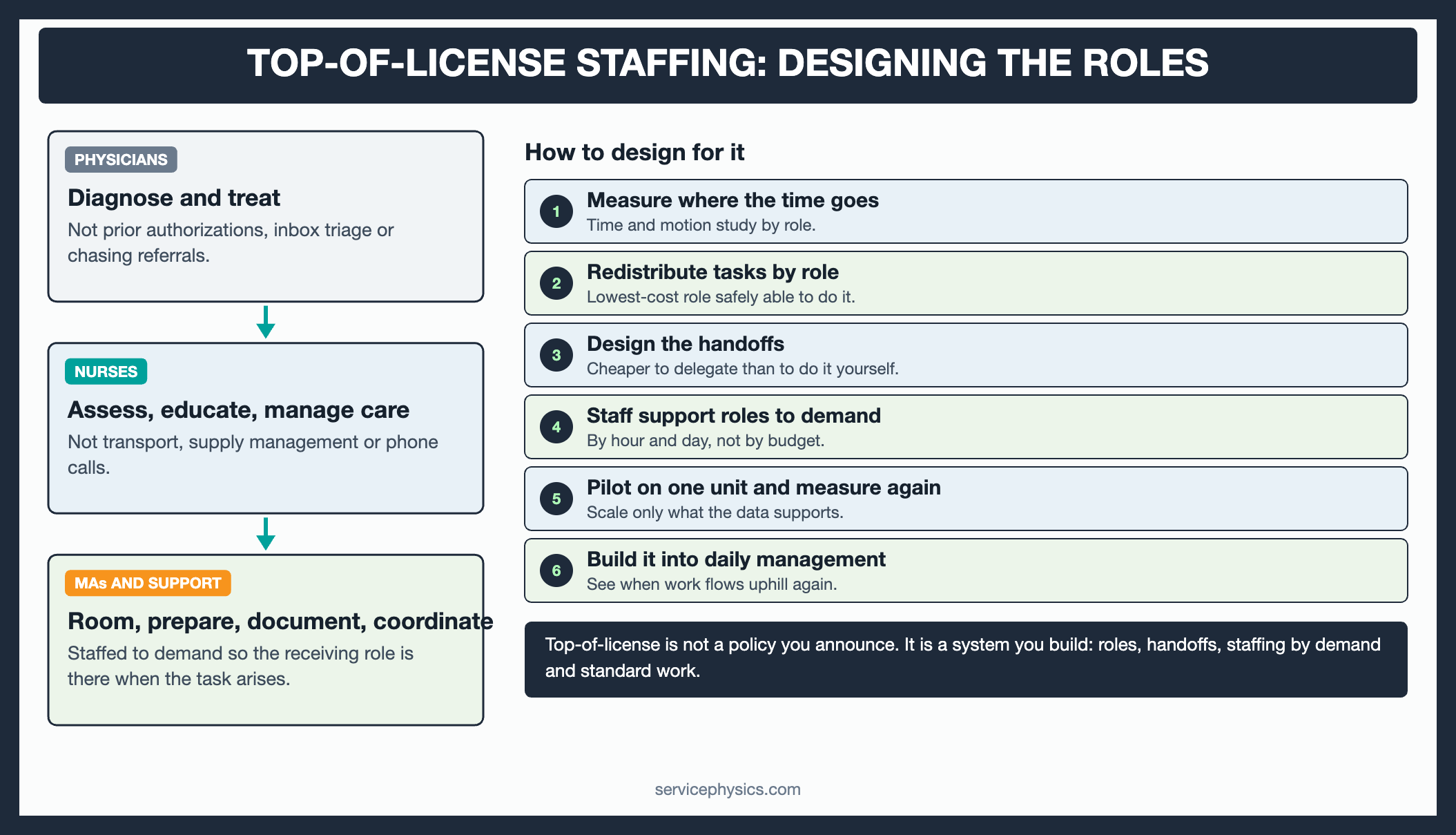
Top-of-license staffing, sometimes called top-of-scope or top-of-skillset staffing, is the practice of designing roles and workflows so that each person spends their time on the highest-value work their license, certification, and training allow, and delegates everything else to the appropriate role. Physicians diagnose and treat. Nurses assess, educate, and manage care. Medical assistants room, prepare, and document. Support staff handle scheduling, supplies, and logistics.
The idea is simple: the most expensive and scarcest people in the building should not be doing work that someone else is trained and permitted to do. What makes it hard is that “someone else” has to exist, be trained, be available at the right moment, and have a clear handoff. Without that, the work flows uphill to whoever is standing there, which is usually the clinician.
Top-of-license is therefore not a policy you announce. It is a system you build: role definitions, task ownership, staffing by demand, standard work, and the physical and digital tools that make delegation faster than doing it yourself.
Why It Matters
Clinician time is the constraint in most healthcare operations. When a physician spends a third of the day on administrative work, the clinic’s capacity is a third smaller than its physician headcount suggests. The organization pays a physician’s rate for clerical output, patients wait longer for appointments, and the physician goes home to finish notes. Burnout, turnover, and access problems all trace back to the same misallocation.
The same holds for nursing. Nurses pulled into transport, supply management, and phone calls have less time for assessment and patient education, which shows up as missed deterioration, longer stays, and readmissions. And the effect compounds: when licensed staff absorb unlicensed work, the unlicensed roles are underused, so the organization concludes it cannot afford more of them.
Done well, top-of-license design recovers capacity from the existing team, improves the experience of the people doing the work, and usually improves quality, because each task is done by the role designed and trained for it.
Why It Fails in Practice
Most organizations that adopt top-of-license staffing do so by policy and training: they tell clinicians to delegate and tell support staff to accept delegation. It rarely holds, for predictable reasons.
The receiving role is not there
Delegation only works if the medical assistant or support person is available at the moment the task arises. When support staffing is thin or badly timed, the clinician does the task rather than wait.
The handoff costs more than the task
If explaining and tracking a delegated task takes longer than doing it, clinicians will do it. Handoffs have to be designed to be faster than the work, with standard formats and tools.
Roles are defined by job description, not by workflow
Job descriptions list responsibilities. Workflows determine who actually does what at 2pm on a Wednesday. Without a designed workflow, the job description is aspirational.
Nobody measures it
Organizations rarely know how much time each role spends on work outside its scope, so they cannot see whether the change worked or where it is slipping.
How to Design for Top-of-License Work
Service Physics approaches top-of-license staffing as service delivery system design, using the same method we apply to any operation where roles, handoffs, and demand have to fit together.
1. Measure where the time goes
Run a time and motion study across the roles in the unit or clinic. Classify every activity by whether it requires the license of the person doing it. The result is a fact base showing how many hours per day of clinical time are consumed by non-clinical work.
2. Redistribute tasks by role
Assign every recurring task to the lowest-cost role legally and safely able to perform it, and document the assignment. This is a workflow decision, made with the clinical team, not an org chart exercise.
3. Design the handoffs
For each delegated task, specify how it is requested, tracked, and closed. Standard formats, visual boards, and in-room tools keep the handoff cheaper than doing the task yourself.
4. Staff support roles to demand
Match medical assistant, technician, and support staffing to patient arrival patterns by hour and day, so the receiving role is present when the work occurs.
5. Pilot on one unit and measure again
Test the redesigned roles on a single unit or clinic, re-observe, and compare clinical time per shift before and after. Scale only what the data supports.
6. Build it into daily management
Use huddles and visual metrics so the team can see when tasks are flowing uphill again and correct it in the moment rather than at the next reorganization.
What It Looks Like in Practice
In a primary care clinic, this often means expanded medical assistant roles that own rooming, pre-visit preparation, standing-order tasks, and inbox triage, with a physician-to-MA ratio set by observed demand rather than by budget. In an inpatient unit it means unit-based support roles that own supplies, transport, and equipment so nurses stay at the bedside, and a documentation workflow that removes duplication. In both, it means leadership routines that watch the balance and intervene early.
The common thread is that the design starts from observation of the real work, not from a target ratio, and that support roles are treated as capacity multipliers rather than overhead.
Frequently Asked Questions
Is top-of-license staffing the same as task shifting?
They overlap. Task shifting usually describes moving specific tasks from higher-trained to lower-trained roles, often in resource-limited settings. Top-of-license staffing is the broader design principle that every role, at every level, should spend its time on the highest-value work it is qualified for, which includes making sure the receiving roles are staffed, trained, and equipped.
Does top-of-license staffing reduce headcount?
Usually it changes the mix rather than the total. Organizations often add or expand support roles and recover a much larger amount of clinical capacity than the support roles cost. The financial case is built on access, throughput, and retention rather than on cutting positions.
How do you measure whether top-of-license staffing is working?
Directly, with observation: the share of each role’s time spent on work requiring its license, before and after. Indirectly, with the operational results it should produce: visits or discharges per clinician per day, appointment access, overtime and after-hours documentation, and staff turnover.
Related Reading
Top-of-license staffing is a specific application of service delivery system design. The measurement behind it is covered in time and motion studies in healthcare, and the routines that sustain it in what is a management system. For the capacity problem it usually solves, see what is patient flow.
Put Clinical Time Back Where It Belongs
Service Physics designs roles, handoffs, and staffing models so clinicians spend their day on clinical work. See our healthcare consulting services or book a strategy call.

Insights in your inbox
Stay ahead of what’s next in service operations. Sign up for the Service Physics mailing list to get our exclusive insights in your inbox.